
Why Does My Dog Circle Before Lying Down?

Dogs commonly circle before lying down as part of their natural settling routine. The behavior may be connected with instinct, preparing a resting spot, checking their surroundings, or simply finding a comfortable position, but sudden or significant changes in how a dog settles are worth paying attention to and discussing with a veterinarian when needed.
Why Circling Is Such a Familiar Dog Behavior
You know the routine. Your dog walks toward their favorite bed, turns around once, then again, perhaps gives the blanket an enthusiastic scratch, completes one last circle and finally drops into the exact position they apparently had in mind all along. For pet parents wondering why dogs circle before lying down, why dogs spin before sleeping, or what certain dog bedtime behaviors mean, those little turns can be surprisingly interesting.
For many dogs, circling is simply part of the transition from being awake and active to getting comfortable enough to rest. Humans have their own versions of this. We straighten a pillow, adjust the blanket, turn onto one side, change our minds and move again before finally falling asleep. A dog cannot fluff a pillow with their hands, but turning, pawing and repositioning can serve a similar purpose in creating a resting spot that feels right.
There is no universally correct number of circles a dog should make. One dog might turn once and immediately settle, while another has performed the same elaborate three-spin bedtime ritual for years. Rather than counting the turns, it is usually more useful to become familiar with what is normal for your individual dog.
That personal baseline matters because everyday behavior can tell you quite a bit about how your pet is moving through their routine. When a dog comfortably circles, lies down and relaxes, the behavior may simply be another charming part of life with them. When the same dog suddenly begins taking much longer to settle, repeatedly stands back up, appears hesitant to lie down or behaves differently in other ways, the change itself deserves more attention than the circling does.
What Instinct May Have to Do With It
One of the most familiar explanations for circling before sleep comes from canine ancestry. Long before domestic dogs had orthopedic beds, blankets and a reserved corner of the sofa, free-ranging canids rested on natural surfaces. Grass, leaves, loose soil and uneven vegetation would have required a little more preparation than the average living-room rug.
Turning around on a patch of vegetation may have helped flatten or rearrange the area before resting. Pawing and scratching could also have changed the shape of the resting spot, making it easier for an animal to position its body comfortably. Over generations, behaviors that once had an obvious practical purpose can remain even when the original environment has changed dramatically.
This is why a dog may still circle on a perfectly smooth bed. The behavior does not necessarily mean there is something underneath the blanket that needs to be flattened; the sequence itself may simply feel natural.
You may also have heard that dogs historically circled to check for insects, snakes or other animals before lying down. It is a plausible interpretation of why inspecting and manipulating a resting area could have been useful in a natural environment, but it is better not to present that explanation as a proven reason behind every modern dog’s bedtime routine. Your dog probably is not conducting a nightly pest inspection of the bedroom carpet.
What these ancestral explanations do show is that apparently quirky behaviors often make more sense when we consider the environments in which canine behavior developed. The comfortable pet sleeping beside you today still carries many behavioral patterns that existed long before dog beds became part of the picture.
Comfort and the Sleeping Environment Matter Too
Instinct may explain part of the behavior, but there is also a much simpler possibility: your dog is trying to get comfortable.
Turning allows dogs to reposition their paws, spine and body before placing their weight on the sleeping surface. Some dogs prefer curling into a tight ball, while others stretch across the entire bed as though personal space were merely a suggestion. A dog may also change sleeping positions depending on the temperature, how secure the environment feels and the type of surface available.
The bed itself can influence the process. A bed that is too small may require more repositioning, while an extremely soft surface can feel less stable for some dogs. Slippery flooring around a sleeping area can also make turning and lowering the body more awkward, particularly for older dogs or pets whose mobility has changed.
Room conditions are worth considering as well. Dogs may choose cooler floor surfaces on warm evenings and curl more tightly when temperatures drop. Noise, household activity and the location of the bed can influence where and how readily some dogs settle. If your dog suddenly abandons a long-time sleeping spot, it can be useful to look at what has changed in the environment before assuming there is a problem.
A comfortable bedtime routine therefore involves more than buying the softest bed available. The goal is to create an area where your dog can safely turn, reposition, stretch and get up again without unnecessary difficulty.
When a Familiar Habit Starts Looking Different
A few familiar circles are one thing. A noticeable change in the routine is something else.
Pet parents are often the first people to notice subtle changes because they see the same behaviors every day. Perhaps your dog normally circles twice and lies down immediately, but now they turn repeatedly and keep getting back up. Maybe they appear reluctant to lower themselves onto the floor, seem unusually stiff after waking, hesitate before climbing stairs or avoid jumping onto a familiar piece of furniture.
None of these observations automatically identifies a medical condition, and circling by itself should not be treated as a diagnostic sign. They are simply pieces of information that can help you recognize when your dog's usual behavior has changed.
Research supports the broader value of paying attention to everyday behavior. Wiseman-Orr and colleagues examined a structured questionnaire for assessing chronic pain in dogs through changes affecting everyday quality of life and behavior. The study does not establish bedtime circling as evidence of pain or a particular condition, but it does reinforce an important point for pet parents: changes in normal activities and behavior can provide useful context when veterinarians evaluate how a dog is feeling.
If a dog suddenly begins circling excessively, seems confused, struggles to settle, loses balance, vocalizes when moving, shows pronounced stiffness or develops other unusual behaviors, speak with your veterinarian. Recording a short video can also be useful because it gives your veterinary team an opportunity to observe exactly what you are seeing at home.
Understanding Common Dog Bedtime Behaviors
Circling is rarely the only part of a dog's bedtime routine. Many dogs combine turning with sniffing, stretching, scratching at blankets or repeatedly choosing the same sleeping position, and understanding the whole pattern gives you better context than focusing on a single behavior.
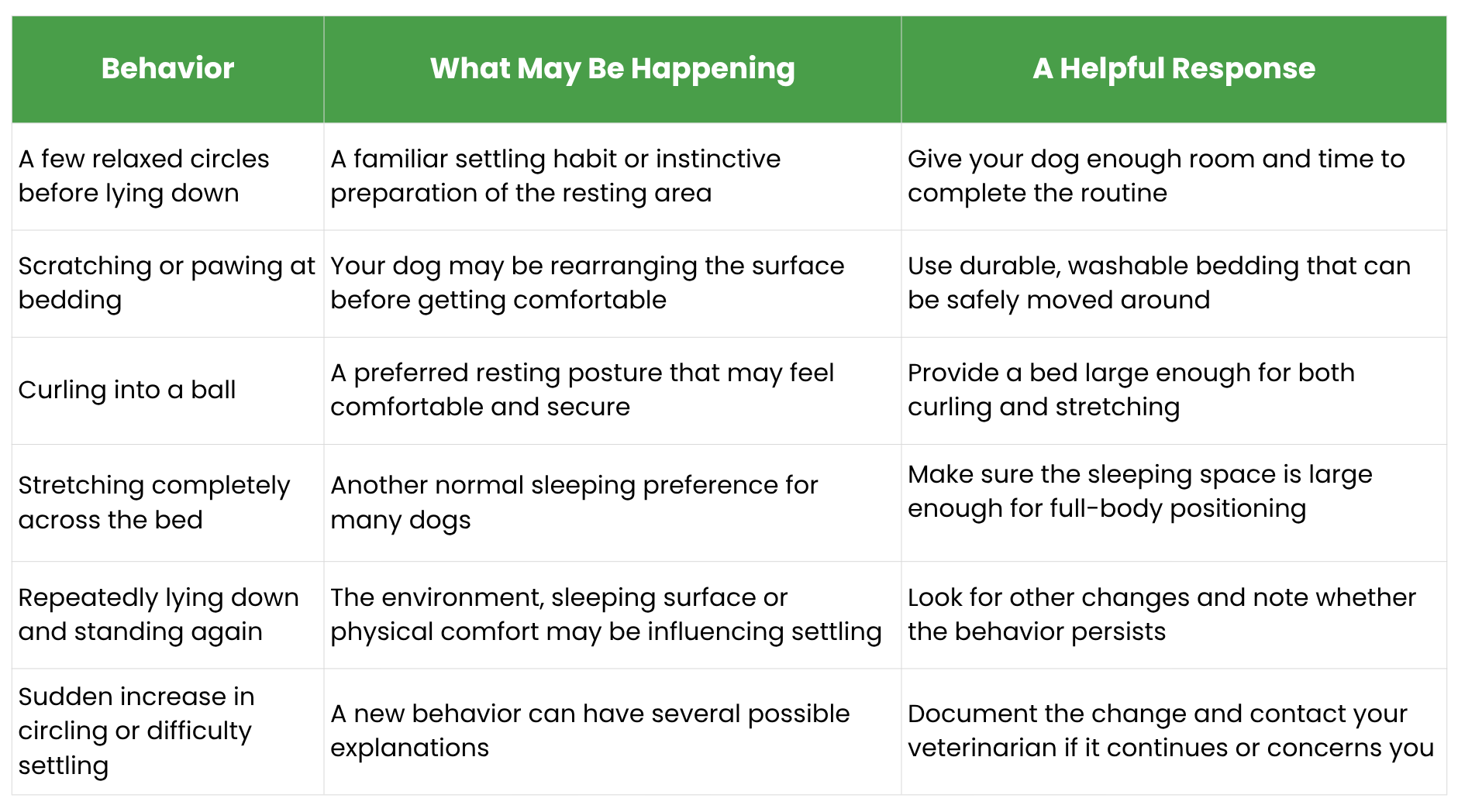
The goal is not to monitor every bedtime movement as though something must be wrong. It is simply to know your dog well enough that a meaningful change stands out when it happens.
Looking at Your Dog’s Whole Daily Routine
Bedtime behavior is also a useful reminder that dog wellness is rarely about one isolated moment. How your pet settles at night is connected to the rest of their day: where they walked, what they ate, how active they were, their grooming routine, oral care, outdoor exposure and even behavioral habits around the home.
After outdoor adventures, for example, a quick coat check can become part of the transition back indoors. Check around the ears, neck, paws, between the toes, underarms and other less visible areas for debris or attached ticks, particularly after time spent around grass or wooded spaces. Regular grooming also gives you an opportunity to become familiar with your dog's skin and coat so that unusual changes are easier to notice.
Daily nutrition deserves the same consistency. Supplements and wellness chews are generally easiest to remember when attached to a routine that already exists, such as breakfast or dinner, rather than being treated as occasional extras. Oral care can similarly become part of the schedule instead of something reserved for the moment bad breath becomes noticeable.
Behavioral habits matter too. Stool eating, for instance, can have different possible contributors and is often best approached through environmental management, observation and veterinary guidance when persistent. The larger point is that responsible dog care is not about finding one product that promises to handle everything; it is about building manageable habits around the individual needs of your pet.
Making Everyday Wellness Easier to Maintain
This is where a targeted approach can be useful. Instead of expecting one chew to address every area of dog wellness, pet parents can choose products according to the part of the routine they want to complement.
Guardian’s Choice (GCP) offers several dog-focused options that fit this approach. The brand’s communication guidelines emphasize transparency about product capabilities and encourage pet parents to think about wellness support without exaggerating what a product can do, while its broader brand pillars center on quality, integrity, trustworthiness and accessible pet-health education.
For nutritional routines, GCP OmegaPaws Chews for Dogs provide an omega-focused soft-chew option, with the product shown in a 90-chew format. If outdoor care is a priority, GCP Flea & Tick Natural Defense for Dogs comes in a 100-soft-chew format and features thiamine, apple cider vinegar, coconut oil and anise as part of its ingredient profile; it can be incorporated alongside regular coat checks and veterinarian-guided parasite care rather than being treated as a substitute for them.
For pet parents paying closer attention to oral-care habits, GCP Breath Boost Bites for Dogs offer another easy-to-add chew format designed around the fresh-breath category. They fit most responsibly alongside tooth brushing, routine dental checks and veterinary dental care rather than replacing those practices.
Finally, GCP No Poo Probiotic Chews – Stool Eating Deterrent provide a targeted option for dog parents dealing with stool-eating behavior. Because that behavior can have more than one possible contributor, the product can be included as one part of a wider approach that also considers supervision, environmental management, feeding routines and professional guidance when the behavior is persistent.
The advantage of having different products for different routines is simple: you can choose what is relevant to your dog instead of adding products they do not need. That kind of individualized approach fits naturally with the small daily habits that already make up responsible pet care.
Frequently Asked Questions
-
Yes, relaxed circling before sleep is common and may simply be part of your dog's normal settling routine. Pay more attention to significant changes in the behavior than to the exact number of circles.
The Little Habits That Tell You a Lot
Your dog's pre-sleep circles may look amusing, but they are also a reminder of how much information is hidden inside everyday routines. The familiar turn, scratch and curl may reflect instinct, environmental preferences and simple comfort, while a noticeable change in those same behaviors can give you an early clue that something about the routine deserves a closer look.
The best approach is not to overanalyze every movement but to become familiar with your individual dog. When you know how they normally walk, rest, eat, play, groom and settle for sleep, changes are easier to recognize and describe when you need professional advice.
That philosophy applies to daily wellness as a whole. Comfortable sleeping spaces, appropriate activity, regular grooming, coat checks, nutrition, oral care and veterinarian-guided preventive care work together over time. Your dog's bedtime spin is only one small piece of the routine, but it is a good reminder that consistent care often happens through the ordinary things you do every day.
Four GCP Options for a More Personalized Dog Wellness Routine
Guardian’s Choice offers dog-focused products for different parts of everyday care, allowing pet parents to choose according to their dog’s lifestyle rather than relying on a one-size-fits-all product. From nutritional and outdoor routines to oral care and behavior-focused support, the range makes it easier to build a routine around the areas that matter most to your household.
-
GCP OmegaPaws Chews for Dogs – 90 Tasty Soft Chews: An omega-focused option for pet parents who want to add this type of nutritional supplement to their dog's everyday routine.
-
GCP Flea & Tick Natural Defense for Dogs – 100 Soft Chews: Features thiamine, apple cider vinegar, coconut oil and anise in a soft-chew format designed for an ingredient-forward outdoor-care routine.
-
GCP Breath Boost Bites for Dogs: A convenient option for pet parents who want to incorporate a fresh-breath product alongside regular brushing and professional dental care.
-
GCP No Poo Probiotic Chews – Stool Eating Deterrent: A targeted chew for households working on stool-eating behavior as part of a broader behavioral and environmental routine.
-
Convenient chew formats: Each product is designed to fit into familiar everyday habits, which can make consistency easier for busy pet parents.
-
Choose according to your dog's needs: The range allows you to focus on the areas that are relevant to your individual dog instead of treating every pet the same.
-
Transparent, function-led product selection: Guardian's Choice uses function-based product naming to make each product's intended category easier for pet parents to understand.
If you are building a more consistent routine for your dog, start with the areas that matter most and choose the GCP products that fit naturally into those habits. Follow each product's label directions, keep regular veterinary care at the center of your dog's wellness plan, and let those small daily routines add up to what Guardian's Choice is all about: Healthier Pets, Happier Lives.
This article is intended for general educational purposes and is not a substitute for individualized veterinary advice. Supplements and wellness products should be used according to their labels and alongside appropriate professional care.
References:
Wiseman-Orr, M. L., Scott, E. M., Reid, J., & Nolan, A. M. (2006). Validation of a structured questionnaire as an instrument to measure chronic pain in dogs on the basis of effects on health-related quality of life. American Journal of Veterinary Research, 67(11), 1826–1836. https://doi.org/10.2460/ajvr.67.11.1826
For all general inquiries, please contact us at info@guardianschoice.com
© Copyright. All rights reserved.