
Why Does Your Cat Knock Things Off Tables?
Cats knock things off tables for reasons tied to hunting instincts, sensory exploration, boredom, and attention-seeking. While it may look like mischief, the behavior is usually your cat’s way of testing movement, making sounds, asking for interaction, or seeking more stimulation at home. A safer setup, structured play, puzzle feeders, vertical spaces, and daily wellness support from GCP Flea & Tick Natural Defense for Cats, GCP Purrbiotics, and GCP Cat L-Lysine can help pet parents build a more thoughtful routine around enrichment, gut health, immune wellness, and seasonal outdoor care.
Why Table-Swatting Is Usually Instinct, Not Attitude
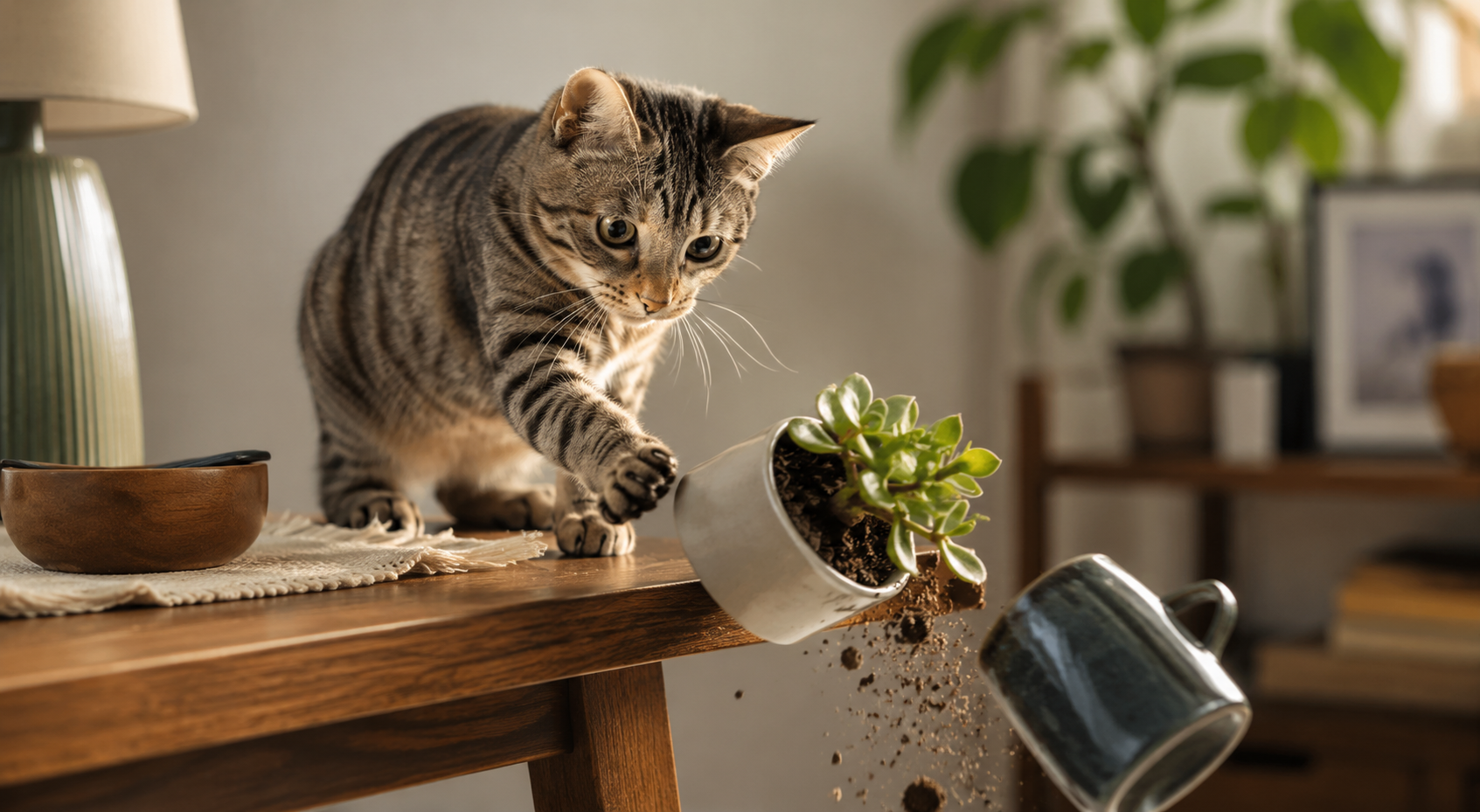
Every cat parent knows the moment. Your cat jumps onto the table, walks slowly toward a pen, a hair tie, or a coffee spoon, then pauses. They look at you. You look at them. Then one paw comes out, the object slides closer to the edge, and gravity takes over. It feels personal, especially when the item is fragile, noisy, or something you clearly did not want on the floor.
Most of the time, though, your cat is not trying to annoy you. Cats do not think about household rules the way people do. They are guided by instinct, curiosity, learned behavior, and their environment. A small object on a flat surface may look boring to us, but to a cat, it can become something worth testing. Will it move? Will it roll? Will it make a sound? Will you react?
Indoor cats still have strong natural needs. They want to stalk, chase, climb, scratch, investigate, and interact with their surroundings. A review on environmental enrichment for indoor cats explains that cats retain natural behaviors such as scratching, chewing, elimination, and exploration even when they live indoors. The review also notes that cats may show unwanted behaviors when they do not have enough appropriate outlets for those behaviors. This does not mean table-swatting is always a serious problem, but it does help explain why enrichment matters in daily feline care.
So before assuming your cat is being “bad,” it helps to ask a better question: what need is this behavior trying to meet?
The Three Main Reasons Cats Push Objects Off Surfaces
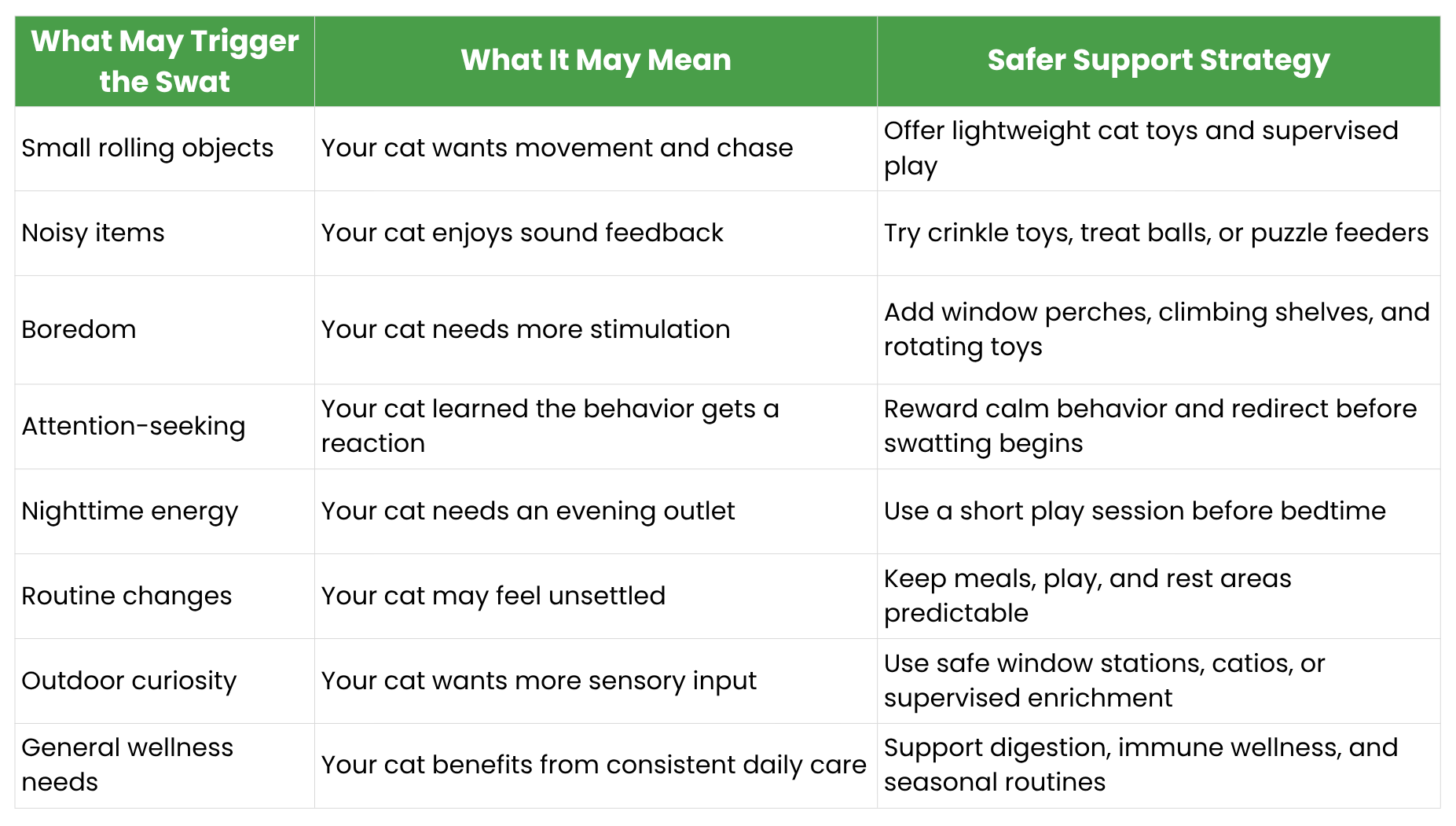
The first reason is hunting instinct. In the wild, cats use their paws to test movement. A small object that rolls, slides, or bounces can mimic the motion of prey. When your cat taps a pen and watches it fall, the movement itself may be rewarding. The object changes position, makes noise, and gives your cat a small burst of action.
The second reason is sensory exploration. Cats use their paws, whiskers, nose, ears, and eyes to understand the world. Knocking an object over lets them learn about weight, texture, sound, and motion. A plastic cap feels different from a metal spoon. A paperclip moves differently from a small toy. The table becomes a tiny science lab, and your cat becomes the researcher.
The third reason is attention. Cats are very good at learning cause and effect. If pushing something off the counter makes you jump up, talk, move closer, or even scold them, your cat may learn that this action gets a response. To a cat, attention is attention. Even a frustrated reaction can become part of the reward loop.
This is why yelling rarely helps. It may make the moment more exciting or stressful, but it does not teach your cat what to do instead. A better approach is to reduce temptation, redirect the behavior, and give your cat more satisfying outlets before they start looking for entertainment on your desk.
When Knocking Things Over Becomes a Household Concern
A cat swatting a harmless toy off the coffee table may be funny. A cat knocking over glass, candles, medication, cleaning products, plants, or sharp objects is a different story. The behavior becomes more concerning when it puts your cat, your home, or other pets at risk.
Start by looking at the surfaces your cat can reach. Counters, desks, nightstands, shelves, bathroom sinks, and kitchen tables often hold small objects that are interesting to cats but not safe for them. Hair ties, rubber bands, pills, essential oils, small batteries, broken glass, sewing supplies, toxic plants, and food scraps should be kept out of reach.
Also consider when the behavior happens. If your cat knocks things over mostly when you are busy, on calls, cooking, or trying to sleep, it may be partly attention-driven. If it happens at night, your cat may need more daytime activity or a more predictable evening play routine. If the behavior suddenly increases, especially along with appetite changes, hiding, vocalizing, litter box changes, or unusual restlessness, it is worth checking in with your veterinarian.
The goal is not to remove all fun from your cat’s life. The goal is to make the home safer while giving your cat better ways to explore.
Cat Behavior and Wellness Support Guide
How to Redirect the Habit Without Stressing Your Cat
The first step is prevention. Clear the surfaces your cat targets most often. Put fragile items away, store medications securely, move toxic plants out of reach, and avoid leaving cups, pens, cords, or small objects near table edges. The fewer rewards available, the less interesting the behavior becomes.
Next, give your cat approved objects to bat, chase, and knock around. Lightweight balls, soft mice, crinkle toys, and treat puzzles can satisfy the same instincts in a safer way. If your cat loves watching items fall, try dropping a soft toy during play or tossing one across the floor so they can chase it.
Structured play is especially helpful. Two or three short sessions a day can make a big difference for many indoor cats. Use wand toys to mimic prey movement: slow crawl, quick dart, pause, hide, then move again. End with a small treat or meal so the play sequence feels complete.
Vertical space also matters. Cats feel more secure when they can climb, perch, and watch from above. A cat tree near a window, a cleared shelf, or a safe climbing route can make the home feel more interesting. Puzzle feeders and foraging games can help, too, especially for cats who need mental stimulation more than intense physical play.
Finally, avoid turning the swat into a show. If your cat pushes something safe off a surface, do not rush over dramatically. Calmly redirect, then reward the behavior you want, such as using a toy, scratching post, perch, or puzzle feeder.
Daily Feline Wellness Support From GCP
Once your cat’s environment is safer and more engaging, daily wellness support can help round out the routine. Cats do best when their care feels consistent: regular meals, clean water, litter box maintenance, brushing, playtime, safe enrichment, and products that support their everyday needs.
For cats who enjoy window watching, catios, balcony time, or supervised fresh-air routines, GCP Flea & Tick Natural Defense for Cats can support their natural seasonal defense routine from within. It pairs well with grooming, coat checks, clean bedding, and safe outdoor-season habits.
For cats whose daily routine includes mealtime support, GCP Purrbiotics offers probiotic and prebiotic support for digestive health, gut balance, immune wellness, and skin and coat health. Digestive wellness matters because a comfortable routine often begins with steady feeding habits and a healthy gut-support plan.
For cats who need daily immune and respiratory wellness support, GCP Cat L-Lysine offers an easy-to-serve option made with L-Lysine. It can fit into a simple routine for pet parents who want to support normal immune function, respiratory wellness, and overall feline health.
These products should not be presented as behavior treatments. They are daily wellness tools that support different parts of your cat’s overall routine while enrichment and safer home setup address the knocking behavior directly.
Frequently Asked Questions
-
Usually, no. Cats do not knock items over because they understand spite in the human sense. The behavior is more often linked to curiosity, hunting instincts, sensory play, boredom, or learned attention-seeking.
Redirect the Swat, Don’t Punish the Cat
Cats knock things off tables because they are curious, intelligent, sensory-driven animals with strong instincts. The behavior may be annoying, but it often tells you something useful: your cat wants movement, sound, attention, or stimulation. Instead of punishing the swat, redirect it toward safer activities that satisfy the same needs.
Clear risky surfaces, offer approved toys, build vertical territory, use puzzle feeders, and create predictable play routines. Then support your cat’s daily wellness with consistent care around digestion, immune wellness, coat checks, and seasonal routines. When the environment and routine work together, your home can feel calmer for you and more satisfying for your cat.
GCP Daily Feline Wellness Picks
GCP offers daily wellness products designed to support different parts of your cat’s routine. Whether your cat needs seasonal outdoor support, digestive wellness, or immune and respiratory wellness support, these products can fit naturally into daily care when used as directed.
GCP Flea & Tick Natural Defense for Cats Benefits:
-
Supports your cat’s natural seasonal defense routine
-
Helps support outdoor-season wellness
-
Supports skin comfort and coat wellness
-
Chicken-flavored soft chews cats can enjoy
-
Easy to pair with grooming, coat checks, and clean bedding
-
Made without harsh chemicals
-
100 soft chews per jar
GCP Purrbiotics Benefits:
-
Supports digestive health in cats
-
Helps support gut balance
-
Supports immune wellness
-
Supports healthy skin and coat
-
Provides 5 billion CFU per scoop
-
Includes probiotic and prebiotic support
-
Chicken liver flavor cats can enjoy
-
Easy to mix into daily meals
GCP Cat L-Lysine Benefits:
-
Supports normal immune function
-
Supports respiratory wellness
-
Helps support overall feline health
-
Supports eye comfort as part of daily wellness
-
Easy-to-serve formula
-
Fits into a consistent daily routine
-
Helpful for pet parents focused on immune wellness support
If your cat’s table-swatting is reminding you that they need more structure, enrichment, and daily care, this is a great time to refresh the full routine. Choose GCP Flea & Tick Natural Defense for Cats for seasonal outdoor support, GCP Purrbiotics for digestive and gut wellness, and GCP Cat L-Lysine for immune and respiratory wellness support. Pair them with play, safe surfaces, fresh water, and regular veterinary guidance to help your cat feel supported from every angle.
Citation: Herron, M. E., & Buffington, C. A. T. (2010). Environmental enrichment for indoor cats. Compendium: Continuing Education for Veterinarians, 32(12), E4. https://pmc.ncbi.nlm.nih.gov/articles/PMC3922041/
For all general inquiries, please contact us at info@guardianschoice.com
© Copyright. All rights reserved.