
The Real Reason Cats Knead Before They Settle Down
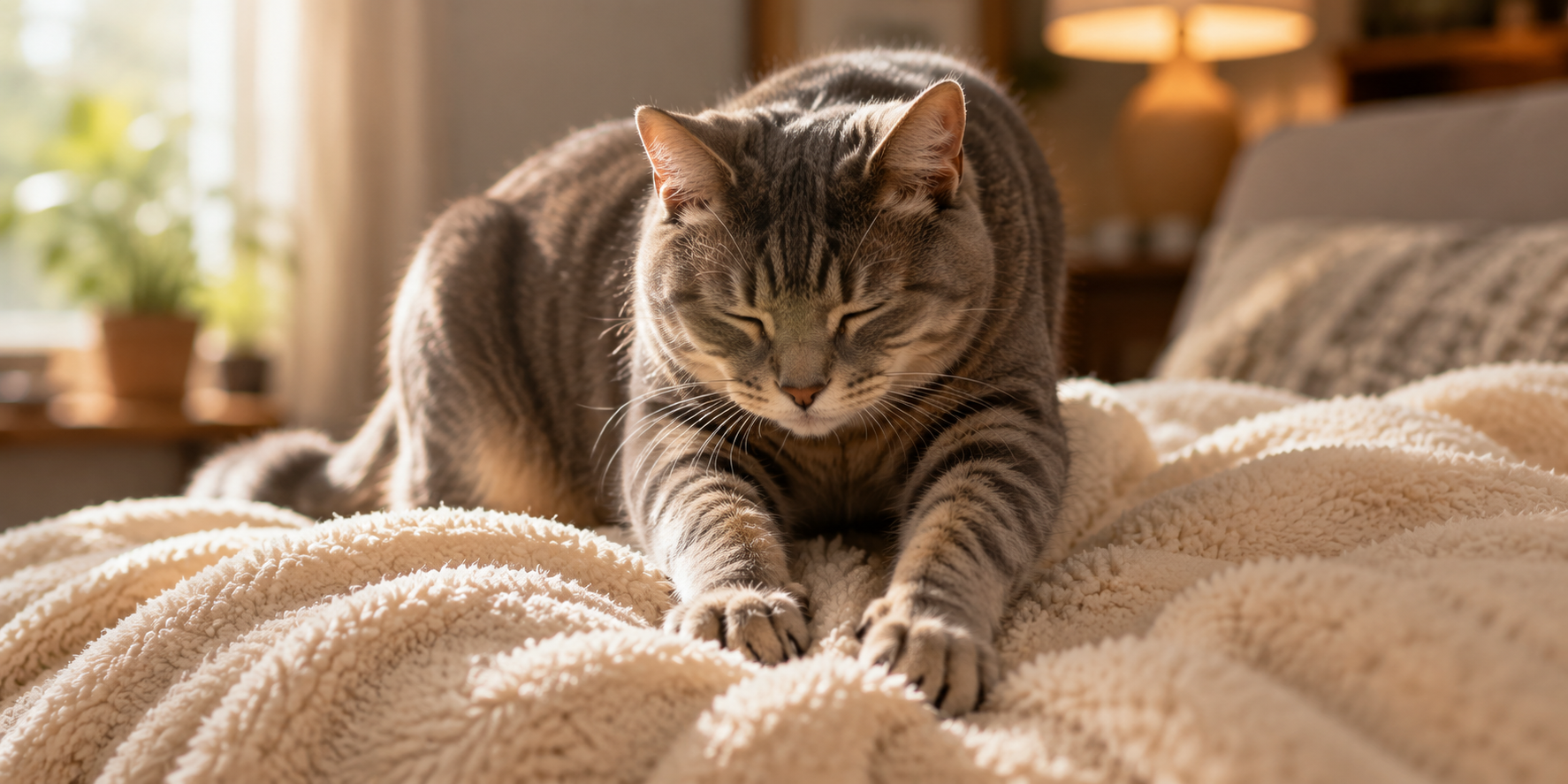
Cats may knead before resting because the behavior begins during kittenhood and can remain part of a familiar adult comfort routine. Kneading may also be connected with stretching, scent communication, preferred resting spaces, or simply the repetitive behaviors an individual cat has learned to associate with settling down, but no single explanation applies to every cat.
Few feline habits are as instantly recognizable as “making biscuits.” Your cat climbs onto a blanket—or directly onto you—places both front paws down, and begins rhythmically pressing one paw and then the other. Sometimes there is purring, sometimes claws appear, and sometimes the whole performance lasts several minutes before your cat circles twice and falls asleep as if nothing happened.
It is charming, but it is also surprisingly interesting from a feline behavior perspective. Why cats knead, why cats knead before sleeping, cat comfort behavior, feline bonding, and cat relaxation habits are frequently discussed because the behavior seems to appear most often in moments when cats are preparing to rest or seeking out a familiar place.
What makes kneading especially fascinating is that scientists do not have one definitive explanation for every adult cat that does it. Several reasonable ideas exist, ranging from kittenhood nursing behavior to scent communication and stretching, but some popular explanations are more speculative than the internet sometimes makes them sound.
Understanding that distinction does not make kneading any less meaningful. It simply gives pet parents a more accurate way to appreciate one of the sweetest behaviors cats carry into adulthood.
Why “Making Biscuits” Starts in Kittenhood
The clearest connection begins very early in life.
Nursing kittens rhythmically press their paws against the area around their mother’s mammary glands while feeding. That movement is part of normal neonatal behavior, and it is easy to understand why adult kneading is commonly linked with this early experience.
What becomes more difficult to prove is exactly why the movement persists into adulthood.
It is often said that adult cats knead because doing so releases oxytocin or directly recreates the hormonal state associated with nursing. While nursing, maternal behavior, and social interactions involve complex hormonal processes, there is not enough evidence to say that every adult kneading session produces a particular hormone response or that this is the established cause of the behavior.
A safer interpretation is that kneading begins during a highly important early-life activity and may persist as part of a familiar behavioral pattern. Adult cats frequently perform it on soft surfaces such as blankets, beds, cushions, clothing, and laps—the kinds of comfortable places where they may also settle down.
That does not mean kneading proves your cat is remembering their mother. Cats are not necessarily replaying a conscious kittenhood memory every time their paws start moving.
It may simply be a behavior that began early and remained part of their adult repertoire because it is associated with familiar, comfortable situations.
Does Kneading Mean Your Cat Feels Safe?
Pet parents understandably love interpreting kneading as a feline compliment. When a cat climbs onto your lap, purrs, kneads your sweater, and falls asleep, the entire sequence certainly looks like trust.
There is good reason to recognize that cats can form meaningful social relationships with their human caregivers. In a study by Vitale, Behnke, and Udell, researchers assessed attachment behavior in cats and kittens and found patterns consistent with secure and insecure attachment styles toward human caregivers.
That study is important because it challenges the old stereotype that cats are emotionally detached from people. However, the researchers were studying attachment behavior—not kneading—so their findings should not be used to say that kneading specifically proves a secure attachment bond.
Instead, look at the whole situation.
A cat who voluntarily approaches you, settles comfortably, maintains a relaxed posture, purrs or rests, and chooses to remain near you may be demonstrating that they are comfortable in that moment. Kneading may simply be one part of that broader behavioral picture.
Body language offers more useful information than one behavior alone. Relaxed ears, soft facial muscles, normal breathing, loose posture, and willingness to settle generally tell you more than the kneading movement by itself.
Scent, Territory, and Familiar Spaces
Another popular explanation is that cats knead in order to leave scent behind.
Cats do communicate chemically, and scent plays an important role in feline social and territorial behavior. They have scent-producing structures in several areas of the body and commonly deposit scent through behaviors such as facial rubbing.
Paw-related scent communication is also discussed in feline behavior, which has led to the suggestion that kneading may help leave an individual scent on a preferred resting place.
That idea is plausible, but pet parents should be careful about treating it as though kneading has been definitively proven to function primarily as territory marking.
Your cat may knead the same blanket every evening because it smells familiar, feels comfortable, sits in a favored location, and is already part of their bedtime routine. The behavior may involve several overlapping motivations rather than one hidden message that says, “This blanket is mine.”
Either way, familiar scent can be reassuring to cats. Constantly washing every favorite blanket in heavily fragranced detergent or repeatedly rearranging their preferred sleeping spaces may make an environment feel less predictable.
Keeping a few dependable resting areas around the home allows your cat to choose where they feel comfortable without requiring you to interpret every paw press as a territorial declaration.
Is Kneading an Ancient Bed-Making Instinct?
You may have heard that domestic cats knead because their wild ancestors pressed down grass and leaves before sleeping.
It is an appealing explanation. Anyone who has watched a cat knead, turn in a circle, and then curl up can easily imagine an ancestral feline flattening vegetation into a comfortable resting place.
The difficulty is that this explanation is largely behavioral speculation, not a firmly established reason for modern feline kneading.
Wild and free-ranging cats certainly select and investigate sleeping areas, but connecting modern kneading directly to ancestral grass-flattening behavior requires more evidence than we currently have.
That does not mean the idea is impossible. It simply belongs in the “possible explanation” category rather than the “scientifically proven reason” category.
For pet parents, the useful takeaway is more practical anyway: cats often like having comfortable places to settle.
Soft blankets, covered beds, window perches, elevated resting spaces, warm areas, cardboard boxes, and quiet corners can all give cats choices. Instead of trying to recreate an ancestral nest, focus on noticing which textures and locations your individual cat repeatedly chooses.
Stretching May Be Part of the Ritual Too
Watch a kneading cat closely and you will notice that the movement involves more than the paws.
The toes spread and flex, wrists move, forelimbs alternate, shoulders shift, and the body may stretch forward and backward as the cat becomes comfortable. It is therefore reasonable to think that kneading can function partly as movement and stretching.
Still, describing kneading as a specific exercise that “conditions muscles,” protects joints, or maintains mobility would go farther than the evidence supports.
Think of it instead as a natural movement your cat performs voluntarily.
Some cats combine kneading with a long front-leg stretch, while others barely move their shoulders at all. Older cats may knead more gently or choose softer surfaces, and cats with painful paws or mobility concerns may modify or stop familiar movements.
Those changes are more useful to notice than trying to turn kneading itself into an exercise program.
If your cat suddenly avoids placing weight on a paw, repeatedly lifts one foot, cries when kneading, limps afterward, or seems uncomfortable when their paws are touched, take a closer look and consider veterinary guidance.
What Different Kneading Behaviors May Mean
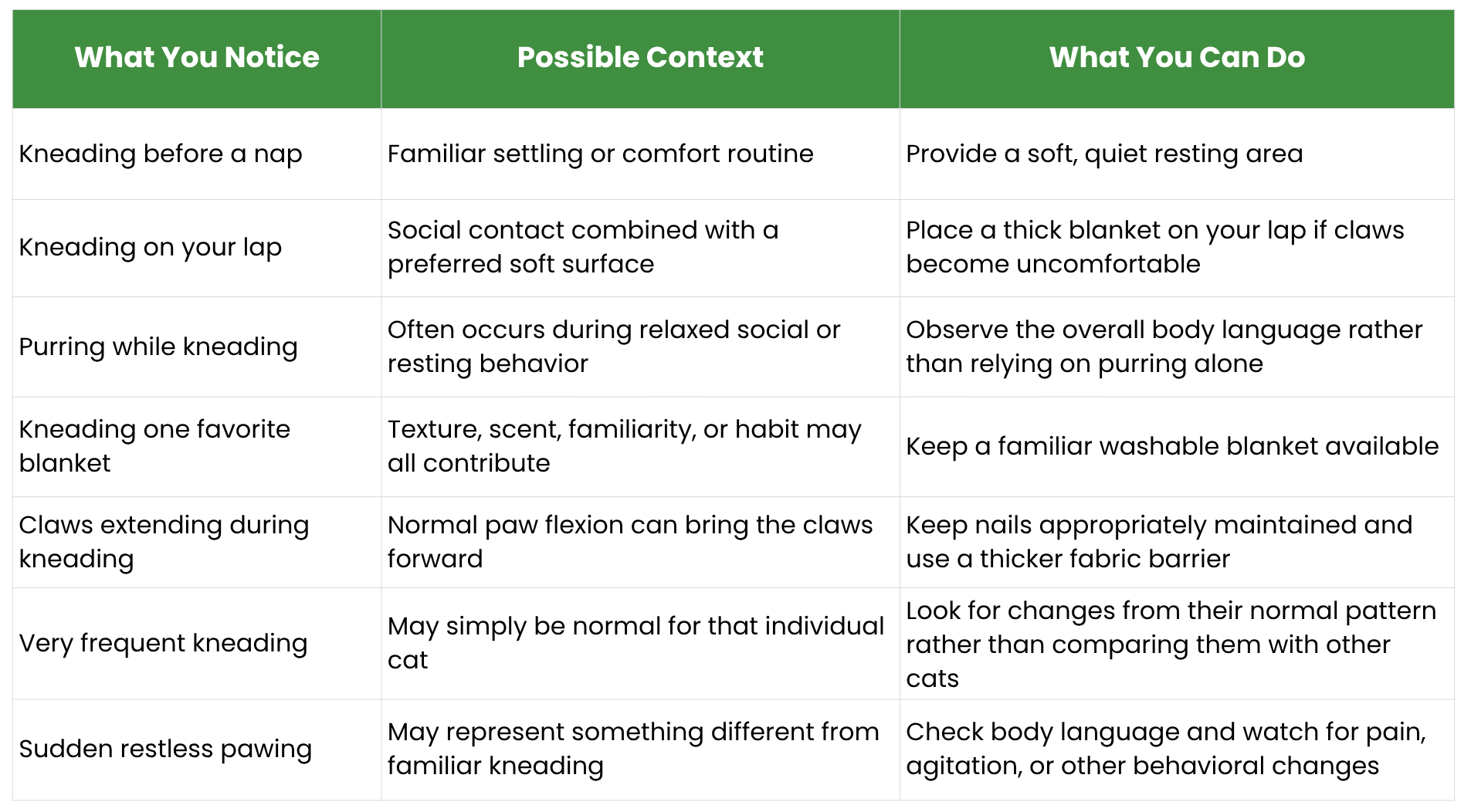
Individuality matters here. Some cats knead every day while others rarely do it at all, and both can be perfectly normal.
When Kneading Deserves a Closer Look
Kneading itself is usually an ordinary feline behavior, so frequency alone does not necessarily indicate a health concern.
What matters more is change.
If your cat has always spent five minutes kneading their favorite blanket before bed, that pattern becomes part of their normal routine. If the behavior suddenly becomes frantic, dramatically more frequent, or appears alongside hiding, reduced appetite, vocalization, limping, excessive grooming, vomiting, diarrhea, or litter-box changes, pay attention to the larger picture.
It is also worth separating kneading from repetitive paw movements caused by discomfort or neurological problems. Familiar kneading generally has a recognizable alternating rhythm and occurs in a predictable context, while unusual movements may look different from what your cat normally does.
Another common concern involves claws. Kneading with claws extended does not necessarily mean your cat is being aggressive. The claws can naturally emerge as the toes flex, which is why a thick blanket between your lap and an enthusiastic biscuit-maker can save both your skin and your relationship.
Avoid punishing your cat for kneading. If the claws hurt, calmly redirect them to a blanket or padded surface rather than turning a familiar comfort routine into an unpleasant interaction.
Creating a Comfortable Daily Routine Around Your Cat
Kneading is a good reminder that feline wellness is not only about what goes into the food bowl. Cats also benefit from predictable environments where they have appropriate places to eat, drink, use the litter box, scratch, climb, hide, play, and rest.
Give your cat several sleeping options rather than expecting one expensive bed to satisfy every mood. Some days they may want a sunny window; other days an enclosed box or quiet bedroom corner wins.
Keep litter boxes clean and accessible, make fresh water easy to find, and provide complete nutrition appropriate for your cat’s life stage. Regular play and climbing opportunities can add variety to indoor life, while grooming gives you a chance to notice changes in skin, coat, body condition, or sensitivity.
Digestive wellness belongs in that broader routine too. Stool changes, vomiting, appetite differences, or abdominal discomfort can affect how a cat behaves and settles, but you should not assume that a cat kneading less means their gut is “out of balance.”
Similarly, immune or respiratory concerns require their own evaluation. Sneezing, eye discharge, difficulty breathing, appetite changes, or lethargy should not be interpreted through kneading behavior.
The most useful habit is simply knowing what is normal for your cat.
Adding Guardian’s Choice Purrbiotics and Cat L-Lysine to Everyday Care
Once complete nutrition, hydration, enrichment, comfortable resting spaces, litter-box care, and veterinary wellness are established, Guardian’s Choice (GCP) offers cat-focused supplements that can fit into an intentional daily routine.
GCP Purrbiotics – Daily Probiotics for Cats can be considered by pet parents interested in adding probiotic supplementation to their cat’s established digestive wellness plan. Probiotic benefits can depend on the specific microorganisms and formulation involved, so it is better positioned as complementary nutritional support rather than something that guarantees perfect digestion or makes a cat calmer, more relaxed, or more likely to knead.
GCP Cat L-Lysine provides supplemental L-lysine in a cat-focused format and can be incorporated when that type of nutritional supplementation is appropriate for the individual cat. It should not be presented as a treatment for respiratory illness or as a way to “strengthen immunity” enough to prevent disease, and cats showing sneezing, eye discharge, breathing changes, or reduced appetite should receive appropriate veterinary attention.
Neither supplement is necessary simply because a cat kneads—or because they do not. Their place in the story is much broader: convenient nutritional options for pet parents who want to thoughtfully personalize an already well-established feline wellness routine.
Frequently Asked Questions
-
Kneading begins during nursing in kittenhood and may remain part of an adult cat’s familiar comfort or settling behavior. Scientists have not established one single reason that explains why every adult cat continues the behavior.
Let Their Little Ritual Stay Comforting
Kneading is one of those behaviors that makes living with cats endlessly interesting. It begins with a movement kittens use during nursing and somehow becomes part of adult life for many cats, appearing on blankets, beds, sweaters, pillows, and unsuspecting human laps.
Several explanations may contribute. Familiar early-life behavior, comfortable textures, social contact, scent, stretching, and settling rituals could all play a role, and different cats may knead in different contexts.
What we do not need is one overly tidy explanation.
Your cat does not have to be consciously remembering kittenhood, releasing a specific relaxation hormone, claiming ownership of your lap, or recreating an ancestral grass nest every time the biscuits begin. Sometimes a familiar behavior is meaningful precisely because it has become part of that individual cat’s routine.
The best response is simple: provide safe, comfortable places to rest, protect your lap with a blanket when necessary, keep nails appropriately maintained, and pay attention to meaningful changes in behavior rather than trying to decode every paw movement.
When the rest of their daily wellness routine is thoughtful and predictable, you can simply enjoy the moment when the paws start moving and your cat decides they have found exactly the right place to settle.
Support Their Everyday Routine With GCP Purrbiotics and Cat L-Lysine
GCP Purrbiotics – Daily Probiotics for Cats and GCP Cat L-Lysine provide two different nutritional options for pet parents who want to personalize an established feline wellness routine. Purrbiotics focuses on probiotic supplementation, while Cat L-Lysine provides supplemental L-lysine, allowing each product to occupy a clear role without being positioned as a treatment for behavioral, digestive, immune, or respiratory disease.
-
GCP Purrbiotics – Daily Probiotics for Cats: A cat-focused probiotic option for an established digestive wellness routine
-
Provides a convenient way to incorporate probiotic supplementation according to current label directions
-
Best used alongside complete nutrition, fresh water, and normal litter-box monitoring
-
Should not be expected to treat vomiting, diarrhea, constipation, or unexplained gastrointestinal symptoms
-
GCP Cat L-Lysine: Provides supplemental L-lysine in a feline-focused format
-
Can be added to an established nutritional routine when appropriate for the individual cat
-
Keeps targeted supplementation separate from claims about curing or preventing respiratory illness
-
Easy to connect with a familiar daily feeding routine according to the product label
-
Both products can complement a broader feline wellness plan built around nutrition, enrichment, hydration, comfortable rest, and veterinary care
-
Neither product should be used as a way to diagnose the reason a cat is kneading—or not kneading
If you are already building a thoughtful routine around your cat’s meals, play, hydration, litter-box habits, and favorite places to relax, GCP Purrbiotics and Cat L-Lysine offer two convenient nutritional options to consider. Choose according to your cat’s individual needs, follow the current label, and keep supplementation in its appropriate role: supporting the broader care routine rather than trying to change a perfectly normal little habit like making biscuits.
Reference
Vitale, K. R., Behnke, A. C., & Udell, M. A. R. (2019). Attachment bonds between domestic cats and humans. Current Biology, 29(18), R864–R865. https://doi.org/10.1016/j.cub.2019.08.036
For all general inquiries, please contact us at info@guardianschoice.com
© Copyright. All rights reserved.