
Why Do Cats Guard the Bathroom Door?
Cats guard bathroom doors because closed doors interrupt their routine, block access to familiar territory, and separate them from their favorite human. What may look like clinginess or mischief is often a mix of curiosity, habit, and a desire to stay connected to the household. A calmer routine can include predictable play, safe enrichment, open-door practice when appropriate, and daily digestive support from GCP Purrbiotics for Cats, which supports gut balance, digestive health, immune wellness, and healthy skin and coat as part of everyday feline care.
Why Closed Doors Are So Interesting to Cats
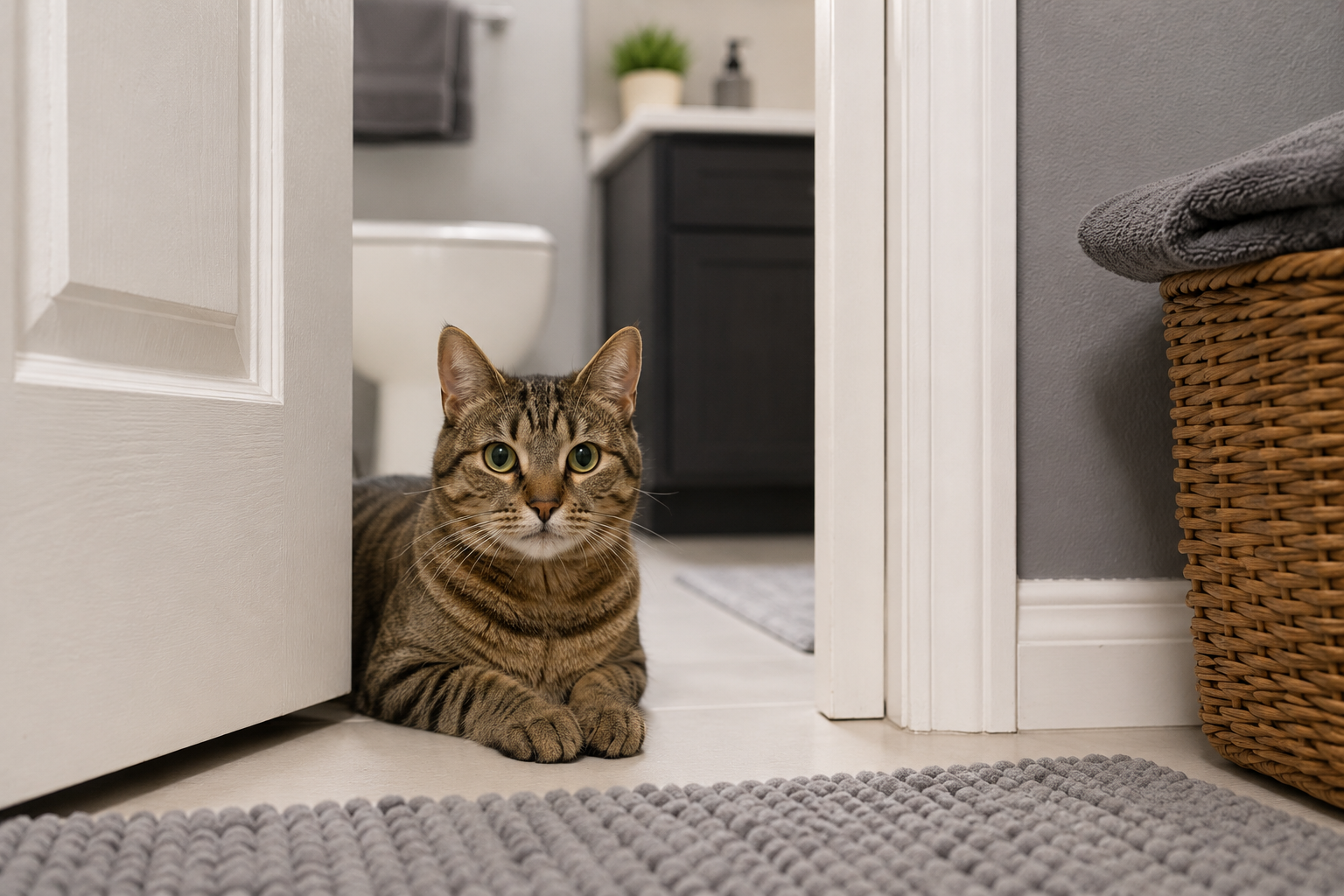
If you live with a cat, privacy can feel like an impossible dream. You walk into the bathroom, close the door, and within seconds, there they are. A paw slides under the crack. A soft meow becomes a louder meow. Maybe they sit like a tiny security guard outside the door, waiting for you to return from what they clearly believe is a very suspicious mission.
This behavior can be funny, but it can also be confusing. Why does your cat suddenly care so much about the bathroom? Why do they ignore you for hours, then act deeply offended the moment you close a door?
The answer starts with how cats see the home. To your cat, the house is not just a collection of rooms. It is their familiar territory. They know the sounds, smells, pathways, furniture, corners, and routines. When a door closes, that familiar map changes. A space they normally access becomes unavailable, and a person they care about disappears behind a barrier.
Cats are also naturally curious. A closed door creates mystery. They cannot see what is happening, cannot inspect the space, and cannot control whether they can enter. For an animal that likes choice and observation, that can be irritating.
The bathroom is especially interesting because it is full of strong scent cues, running water, soft rugs, towels, and predictable human routines. Your cat may not understand why you want privacy, but they understand that something is happening behind the door, and they would very much like to be included.
The Three Main Reasons Cats Guard the Bathroom Door
The first reason is territory. Cats are territorial animals, and many of them prefer open access to the spaces they consider part of their home. A closed bathroom door can feel like a sudden boundary in a place that usually belongs to them too. Guarding the door, pawing at it, or waiting outside may simply be your cat’s way of saying, “Why is this part of my house closed?”
The second reason is attachment. Cats may have a reputation for being independent, but many cats form strong bonds with their humans. Your cat may follow you from room to room because your presence is part of their routine. When you disappear into the bathroom, they may wait nearby because they want to stay close. This does not always mean something is wrong. Sometimes it is just your cat’s version of companionship.
The third reason is curiosity and learned behavior. If your cat meows at the bathroom door and you talk back, open the door, laugh, or give them attention afterward, they may learn that door guarding gets a response. Even a quick “What are you doing?” can be enough to make the behavior more interesting. Cats are smart, and they quickly notice which actions bring their human back into the conversation.
This is why punishing the behavior usually does not help. It may make the moment more stressful, but it does not teach your cat what to do instead. A better approach is to understand the need behind the behavior and give your cat calmer, more appropriate outlets.
When Door Guarding Becomes a Routine Concern
Bathroom guarding is usually normal, especially if your cat is otherwise eating well, using the litter box normally, playing, resting, and acting like themselves. Many cats simply dislike closed doors. However, the behavior may need more attention if it becomes intense, sudden, or paired with other changes.
For example, if your cat scratches heavily at the door, cries loudly for long periods, pants, hides afterward, stops eating, becomes aggressive, or seems unable to settle when separated from you, it may be time to look more closely at their environment and routine. These signs do not automatically point to one cause, but they do suggest your cat may need extra support or veterinary guidance.
Sometimes door guarding increases during routine changes. Moving homes, new pets, new people, schedule shifts, travel, construction noise, or changes in feeding time can all affect how secure a cat feels. If the bathroom is one of the few places where you disappear behind a barrier, your cat may focus on that door more during unsettled periods.
Daily comfort also matters. A cat who does not feel physically comfortable may become more sensitive to changes in their environment. Digestive routine, appetite, stool quality, grooming habits, skin and coat condition, and energy level all give pet parents clues about overall wellness. That is why a whole-cat approach works best: support the environment, support the routine, and support daily wellness from within.
Cat Door Behavior and Wellness Guide
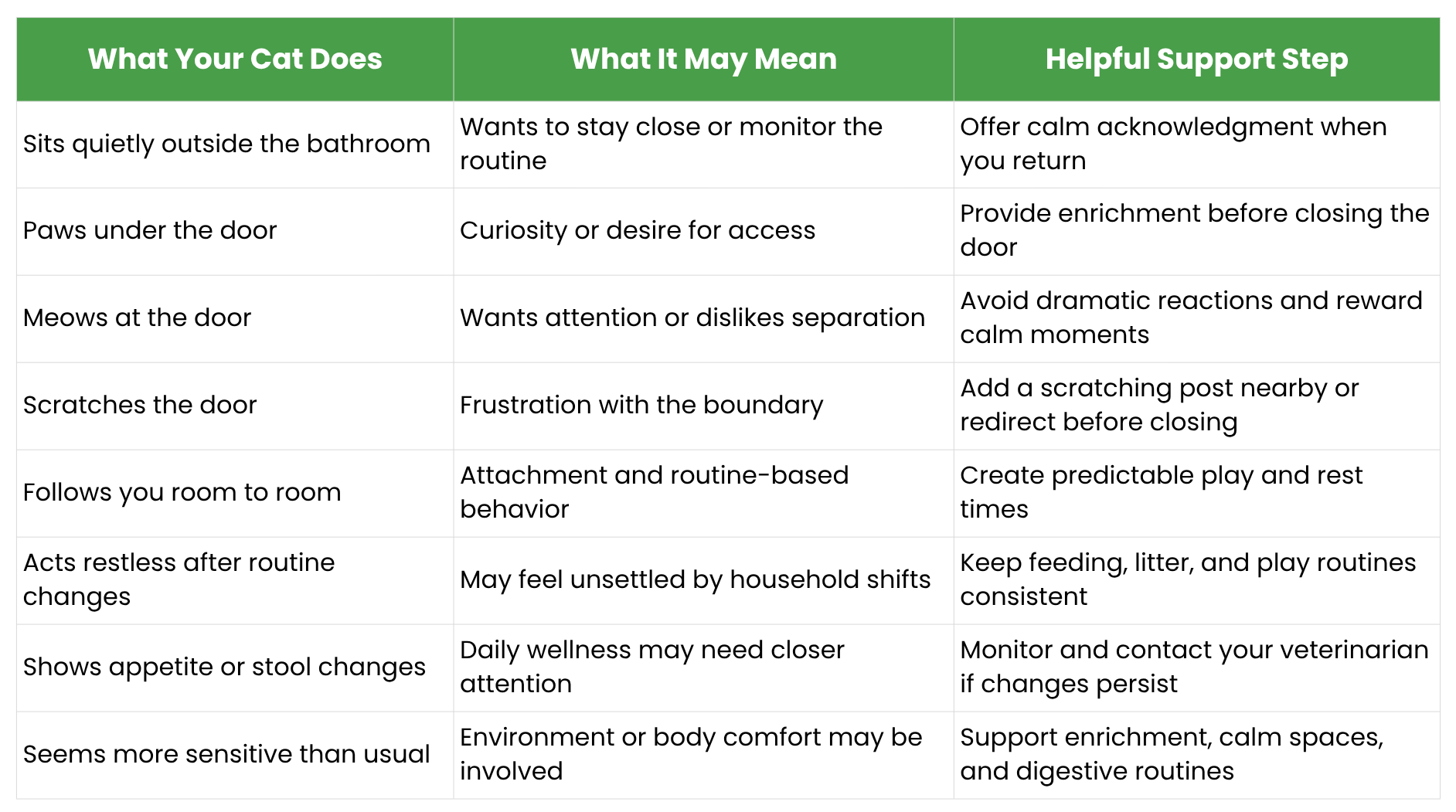
This table can help pet parents respond without overreacting. Most bathroom-door behavior is not a serious problem. It is usually a sign that your cat likes access, routine, and connection. The goal is not to stop your cat from caring about you. The goal is to help them feel secure when the door closes.
How to Support a More Relaxed Home Routine
Start with predictable enrichment. Cats do better when they have daily outlets for normal feline behaviors like climbing, scratching, chasing, sniffing, hiding, and observing. A cat tree, window perch, puzzle feeder, scratcher, cardboard box, or short wand toy session can make a big difference, especially before times when you know you will close a door.
Try offering a small play session before your usual bathroom or shower routine. A few minutes with a wand toy can help your cat release energy in a more satisfying way. After play, you can offer a meal or treat so the sequence feels complete: hunt, catch, eat, groom, rest. This mirrors a natural rhythm many cats enjoy.
You can also make the hallway less exciting. If your cat guards the door because they want attention, avoid making the moment dramatic. Do not yell, chase, or turn it into a game. When you come out, stay calm. Reward quiet behavior with attention when your cat is not scratching or crying. Over time, this helps teach that calm waiting works better than loud protest.
For some cats, a nearby comfort station helps. Place a soft bed, scratcher, or box close to the bathroom but not directly blocking the door. This gives your cat a place to wait without feeling shut out. If the behavior is intense or sudden, consider whether anything else in the home has changed. Cats are sensitive to small shifts, and sometimes the bathroom door is only the most visible part of a bigger routine disruption.
Daily Digestive Support With GCP Purrbiotics
This is where GCP Purrbiotics for Cats fits naturally into the bigger wellness picture. Bathroom door guarding is not a digestive issue, and a probiotic should not be described as a behavior treatment. But daily digestive support can still be part of a thoughtful routine for cats, especially when pet parents want to support overall wellness from within.
Research in cats has explored connections among behavior, hormones, and gut microbiome composition. One study published in PLOS ONE observed group-living domestic cats and reported relationships among social behavior, hormone concentrations, and gut microbial composition. The study was not about bathroom doors, and it does not prove that probiotics change household behavior. It does, however, support the broader idea that feline wellness is complex and that the gut microbiome is part of a larger whole-body picture.
GCP Purrbiotics is designed to support digestive health, gut balance, immune wellness, and skin and coat health. It can fit into a consistent mealtime routine, which many cats appreciate because predictability helps the day feel more stable. For cats who react strongly to routine changes, a steady feeding and wellness schedule may help pet parents create a calmer daily rhythm overall.
Think of Purrbiotics as one part of the routine: enrichment for the mind, safe spaces for comfort, and digestive wellness support from within.
Frequently Asked Questions
-
Your cat may wait outside the bathroom because they want access to their territory, want to stay close to you, or are curious about what is happening behind the door. The bathroom also has interesting smells, sounds, water, towels, and routines that can make it a high-interest space.
Your Cat’s Door Obsession Is Usually About Connection
A cat guarding the bathroom door may seem funny, dramatic, or slightly intrusive, but it usually comes from normal feline instincts. Closed doors interrupt territory, block access, and separate your cat from a person they care about. Your cat may not understand privacy, but they do understand routine, connection, and control.
The best response is not punishment. It is support. Give your cat safe enrichment, predictable play, calm waiting spots, and steady daily care. When their environment feels more satisfying and their routine feels more consistent, closed-door moments may become easier for both of you.
Purrbiotics for Cats
GCP Purrbiotics for Cats is a daily probiotic and prebiotic powder designed to support digestive health, gut balance, immune wellness, and skin and coat health. It fits easily into mealtime routines and gives pet parents a simple way to support feline wellness from within.
Benefits:
-
Supports digestive health in cats
-
Helps support gut balance
-
Supports immune wellness
-
Supports healthy skin and coat
-
Provides 5 billion CFU per scoop
-
Includes probiotic and prebiotic support
-
Chicken liver flavor cats can enjoy
-
Easy to mix into daily meals

If your cat is sensitive to routine changes, curious about every closed door, or simply needs steady daily digestive support, GCP Purrbiotics can be a thoughtful addition to their routine. Pair it with enrichment, clean water, balanced meals, calm spaces, and regular veterinary guidance for a simple whole-cat wellness plan.
Citation: Koyasu, H., Takahashi, H., Yoneda, M., Naba, S., Sakawa, N., Sasao, I., Nagasawa, M., & Kikusui, T. (2022). Correlations between behavior and hormone concentrations or gut microbiome imply that domestic cats (Felis silvestris catus) living in a group are not like “groupmates”. PLOS ONE, 17(7), e0269589. https://doi.org/10.1371/journal.pone.0269589
For all general inquiries, please contact us at info@guardianschoice.com
© Copyright. All rights reserved.