Common Dog Behavior Issues and Tips to Fix Them

Common dog behavior issues such as barking, chewing, leash pulling, and anxiety are often linked to unmet needs like mental stimulation, physical activity, or environmental consistency. These behaviors are not signs of disobedience, but signals that something in your dog’s routine or internal state needs attention. By identifying the root cause and combining structured training with consistent daily habits and wellness support, pet parents can gradually guide their dogs toward calmer, more responsive behavior while strengthening their overall bond.
Why “Bad Behavior” Isn’t What You Think
When dogs bark excessively, chew furniture, or pull relentlessly on the leash, it is easy to interpret these actions as stubbornness or disobedience. However, behavior in dogs is rarely random. It is communication. Every action, even the frustrating ones, reflects an internal or environmental trigger.
Dogs operate on instinct and association. When those instincts do not have a clear outlet, they find one. A shoe becomes a chew toy. A passing car becomes something to alert. An empty house becomes a source of stress.
Shifting your perspective from correction to understanding changes the entire approach. Instead of reacting to the behavior itself, you begin addressing what drives it. This creates a more sustainable path forward, both for training and for your relationship with your dog.
The Three Root Causes of Dog Behavior
Most behavioral challenges can be traced back to three overlapping categories. While each dog is different, these patterns appear consistently across breeds, ages, and environments.
Boredom
Dogs are intelligent animals that require mental engagement. Without it, they seek stimulation on their own terms. This often results in behaviors that feel destructive but are actually exploratory.
Anxiety
Changes in routine, unfamiliar environments, or separation can create uncertainty. Dogs may respond through vocalization, pacing, or repetitive behaviors. These responses are not intentional disruptions. They are attempts to cope.
Excess Energy
Dogs with unused physical energy need an outlet. Without structured activity, that energy often surfaces as hyperactivity, pulling, or restlessness.
These categories rarely exist in isolation. A dog that lacks stimulation may develop anxiety. A dog with anxiety may display destructive behaviors. Understanding how these factors interact is key to managing them effectively.
Common Behaviors and What They Mean
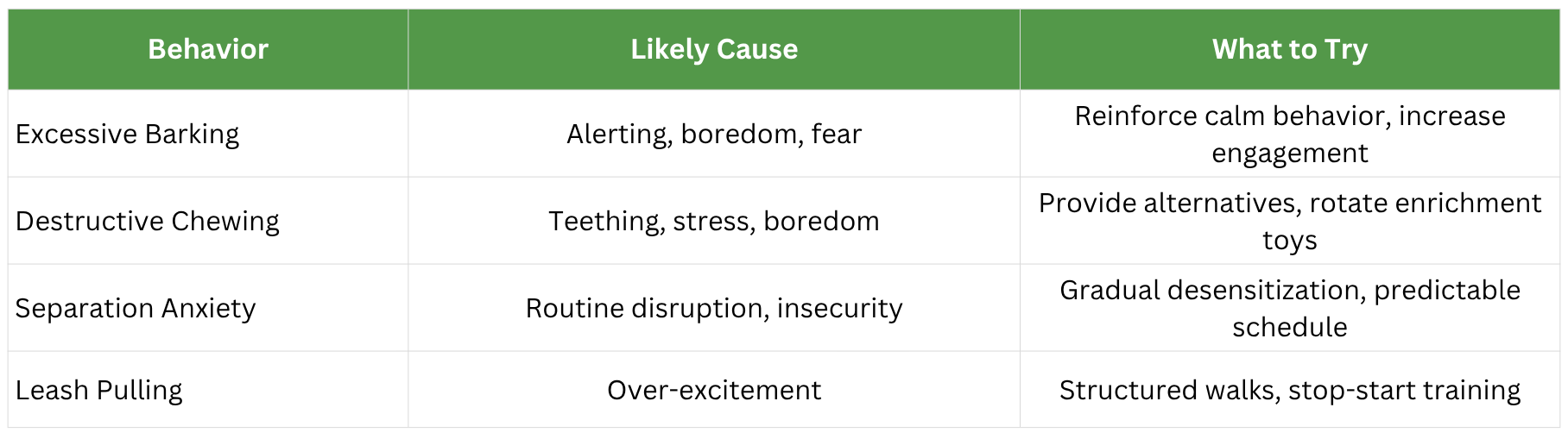
This table is not meant to diagnose but to guide observation. Recognizing patterns helps you respond more effectively.
The Science Behind Behavior and Stress
Modern research in animal behavior highlights the connection between environment, physiology, and response patterns. Dogs do not simply “choose” behaviors. Their nervous system plays a role in how they react to stimuli.
For example, studies in animal behavior and veterinary science have shown that stress responses can influence vocalization, repetitive behaviors, and overall reactivity. These responses are tied to neurological and hormonal processes rather than intentional disobedience.
This perspective reinforces an important idea: behavior is not just external. It is influenced by internal states as well.
Why Training Alone Isn’t Always Enough
Training remains one of the most important tools in shaping behavior. However, training is most effective when a dog is able to focus, process, and respond.
When a dog is overstimulated, anxious, or physically restless, learning becomes more difficult. Commands may be ignored not because the dog does not understand them, but because their internal state does not allow for a clear response.
This is why a combined approach often works best. Training provides structure. Routine provides predictability. Internal balance supports receptiveness.
Nutritional support is sometimes included in this broader approach, not as a replacement for training, but as a way to maintain a more stable baseline that supports learning and adaptation.
Supporting Behavior Through Daily Routine
Consistency is one of the most powerful tools in behavior management. Dogs thrive on predictability. When daily life follows a pattern, it reduces uncertainty and helps regulate responses.
A balanced routine often includes:
-
Structured physical exercise
-
Mental stimulation, such as puzzles or scent work
-
Consistent feeding schedules
-
Designated rest periods
-
Positive reinforcement training
Over time, these habits create a rhythm that dogs can rely on. This reduces the likelihood of stress-driven behaviors and improves responsiveness.

Where GCP Fits Into the Routine
Daily wellness support can complement behavioral routines by helping maintain overall condition and consistency.
-
GCP VitaPup Multivitamin Chews Designed to support daily nutritional balance, particularly during growth stages
-
GCP OmegaPaws Premium Krill Omega-3 Provides Omega fatty acids commonly included in wellness routines focused on skin and coat maintenance.
-
GCP Breath Boost Bites Supports oral hygiene as part of everyday care.
-
GCP Flea & Tick Natural Defense Supports skin comfort as part of grooming and hygiene routines.
These products are designed to integrate into existing habits, making them easier to maintain over time without adding complexity.
The Bigger Picture
Behavior is not something to eliminate. It is something to guide. When you combine understanding, routine, and consistency, behavior begins to shift naturally. The goal is not perfection. It is progress. Small improvements, repeated daily, lead to meaningful change.
A dog that feels engaged, supported, and understood is more likely to respond positively. This is where training, environment, and daily care intersect.
Frequently Asked Questions
-
Behavior changes often reflect shifts in routine, environment, or physical condition. Observing recent changes can provide useful insight.
A More Balanced Approach to Behavior
Understanding your dog’s behavior is less about control and more about awareness. When you recognize the signals behind actions, you gain the ability to respond in a way that supports long-term change.
By combining structured training, consistent routines, and supportive daily care with products like GCP VitaPup, OmegaPaws, Breath Boost Bites, and Flea & Tick Natural Defense, you create an environment where your dog can feel more balanced and responsive.
And in that environment, behavior becomes easier to manage, not because it disappears, but because it finally makes sense.
Product Feature Spotlight: Designed for Real-Life Routines
Building a consistent routine is often the hardest part of managing behavior. The goal is not just choosing the right products, but choosing ones that are easy to use every single day. This is where the GCP lineup is intentionally designed to fit into real-life pet parenting.
Here’s what makes each product practical for daily use:
GCP VitaPup Multivitamin Chews
-
Pre-measured chew format removes guesswork from daily nutrition
-
Designed for easy pairing with regular feeding schedules
-
Ideal for establishing early-life routines in growing dogs
GCP OmegaPaws Premium Krill Omega-3
-
Krill-based formulation known for its phospholipid structure
-
Soft chew delivery helps simplify long-term consistency
-
Easy to incorporate without changing your dog’s existing diet
GCP Breath Boost Bites
-
Treat-style format turns routine care into a positive experience
-
No brushing or prep required, reducing resistance
-
Convenient for multi-dog households with different temperaments
GCP Flea & Tick Natural Defense
-
Designed for daily use rather than occasional application
-
Eliminates the need for messy topical routines
-
Fits seamlessly into existing supplement schedules
Instead of adding complexity, these products are structured around one principle: if it’s easy to maintain, it’s easier to stay consistent. And when it comes to behavior, consistency is often what makes the biggest difference over time.
For all general inquiries, please contact us at info@guardianschoice.com
© Copyright. All rights reserved.