Topical Treatments vs Soft Chews: A Smarter Approach
to Dog Wellness

Topical treatments are often chosen for convenience, but they come with limitations such as inconsistent absorption, application challenges, and variability based on coat and skin condition. Oral soft chews offer a more consistent and measurable approach by delivering nutrients through the digestive system, where absorption pathways are better understood. A daily routine built around targeted soft chews may help support multiple aspects of dog wellness in a simpler, more reliable way. The GCP Soft Chew Line for Dogs is designed to fit seamlessly into this type of routine.
The Appeal of Topical Treatments
Topical treatments are widely used because they seem simple. Apply the product, target a specific area, and expect localized results. For busy pet owners, this feels efficient and straightforward.
They are often used for concerns like flea exposure, skin issues, or joint discomfort. The idea of applying something directly to the surface creates the impression of immediate action.
However, what appears simple on the surface does not always reflect what is happening beneath it. The effectiveness of any topical product depends heavily on factors that are not always visible or controllable.
The Hidden Challenges of Topicals
While topical treatments may appear convenient, they introduce several variables that can influence consistency.
Absorption Variability
A product must pass through fur, skin layers, and biological barriers before it can be utilized. Coat thickness, skin condition, and even grooming habits can affect how much is actually absorbed.
Application Inconsistency
Ensuring even application can be difficult, especially with active dogs. Movement, licking, or environmental exposure may reduce effectiveness.
Surface Residue
Many topical products leave behind residue, which may indicate incomplete absorption. This can also transfer onto furniture or human contact surfaces.
Unpredictable Distribution
Once applied, distribution across the body may not be uniform. This creates variability in how the product interacts with different systems.
These factors do not make topicals unusable, but they do highlight the complexity behind what initially seems like a simple solution.
Why Absorption Matters More Than Application
The key difference between topical and oral approaches lies in how the body processes them.
Topical applications rely on external penetration, which can be inconsistent due to physical barriers. In contrast, oral supplements rely on digestive absorption, where nutrients follow more predictable biological pathways.
When a supplement is consumed, it enters systems designed specifically for nutrient processing and distribution. This allows for a more controlled and measurable intake.
Rather than depending on external conditions, oral delivery aligns more closely with how the body naturally absorbs and utilizes nutrients.
The Oral Advantage: Why Chews Stand Out
Soft chews simplify the process by combining precision, consistency, and ease of use into a single daily habit.
Consistent Intake
Each chew provides a measured amount, removing guesswork.
Simplified Routine
No need for application, drying time, or surface management.
Palatability
Dogs are more likely to accept a chew as part of a routine compared to topical application.
Routine Integration
Chews fit naturally into feeding schedules, making consistency easier to maintain.
Instead of managing external application variables, soft chews focus on internal consistency.
The Role of Targeted Daily Supplementation
Daily supplementation becomes more effective when it is both consistent and targeted. Rather than relying on a single product to address multiple concerns, targeted support allows each area of wellness to be addressed individually while still working together as part of a routine.
Soft chews are particularly well-suited for this approach because they allow for easy combination without adding complexity. Each product can focus on a specific function while remaining part of a simple daily habit.
Flea & Tick Support
GCP Flea & Tick Natural Defense Soft Chews provide a chew-based alternative to topical applications.
-
Includes Thiamine, Apple Cider Vinegar, Coconut Oil, and Anise
-
No external application required
-
Designed for consistent daily use
Foundational Nutrition
GCP VitaPup Multivitamin Chews support daily nutritional intake.
-
Includes essential vitamins and minerals
-
Designed to complement regular feeding
-
Supports structured daily routines
Breath & Digestive Balance
GCP Breath Boost Bites focus on oral and digestive balance.
-
Includes parsley, chlorophyll, and mushroom-based ingredients
-
Designed for daily use
-
Easy addition to routine care
Skin & Coat Support
GCP OmegaPaws Chews provide nutritional support for skin and coat.
-
Includes omega fatty acids
-
Supports coat condition
-
Designed for consistent intake
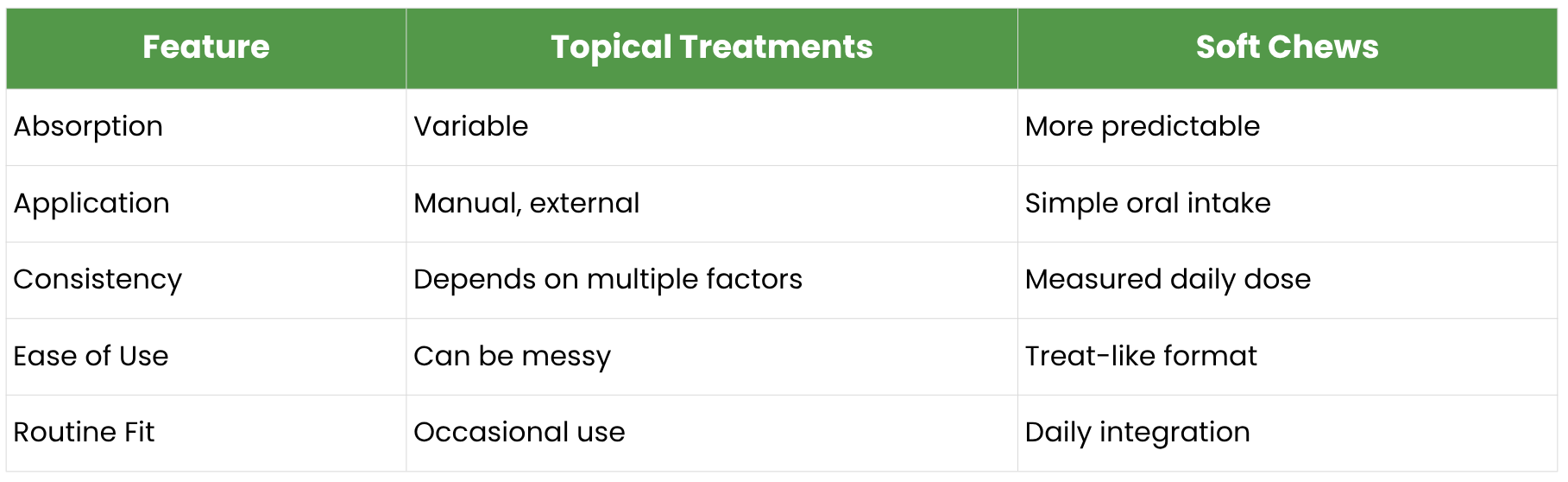
Side-by-Side Comparison: Topicals vs Soft Chews
Supporting Research
Research has explored how nutrition and digestive physiology influence how nutrients are processed and utilized in animals.
A publication in Frontiers in Veterinary Science highlights the integrated relationship between nutrition and digestive systems, emphasizing how internal pathways play a key role in nutrient utilization and overall physiological balance.
Citation: Cai D, Liu H-Y, Dong H, Ahmed AA. Editorial: Integrated role of nutrition and digestive physiology for animal health, Volume II. Front Vet Sci. 2022.
Frequently Asked Questions
-
Not necessarily. They can be useful in certain situations, but results may vary due to absorption and application factors.
Rethinking Daily Dog Care
Topical treatments may offer convenience at first glance, but their effectiveness often depends on variables that are difficult to control. When consistency becomes the goal, oral soft chews provide a more structured and predictable approach.
By shifting from external application to internal support, pet owners can simplify routines while maintaining a more consistent daily intake. Over time, this approach allows for a more stable foundation that supports multiple aspects of a dog’s wellness.
GCP Soft Chew Routine for Dogs
If you’re looking to move away from messy, inconsistent topicals, the GCP Soft Chew Line for Dogs offers a cleaner, more structured alternative:
GCP Flea & Tick Natural Defense Soft Chews
-
No topical application
-
Easy daily routine
-
Supports environmental awareness
GCP VitaPup Multivitamin Chews
-
Foundational nutrition support
-
Complements daily feeding
GCP Breath Boost Bites
-
Supports breath and digestive balance
-
Simple daily addition
GCP OmegaPaws Chews
-
Supports skin and coat condition
-
Provides omega fatty acids
Why choose GCP soft chews:
-
No harsh chemicals
-
No mess or residue
-
Simple, consistent daily routine
-
Designed to support multiple areas of wellness
By choosing a chew-based routine, you’re not just replacing topicals—you’re building a more consistent and manageable approach to daily dog care.
For all general inquiries, please contact us at info@guardianschoice.com
© Copyright. All rights reserved.