
Never Run Out: How Flea & Tick Multi-Packs Simplify Daily Care for Dogs & Cats

Flea and tick care is often treated as a seasonal task, but both dogs and cats may still have exposure throughout the year depending on weather, household conditions, travel, wildlife, and daily routines. A consistent wellness plan that includes coat checks, clean bedding, environmental care, veterinary guidance, and easy-to-follow daily soft chews can help pet parents stay organized without scrambling to reorder at the last minute.
When pet parents think about fleas and ticks, they often picture summer walks, backyard playtime, and warm afternoons at the park. That makes sense because outdoor activity increases during warmer months, and seasonal pests tend to become part of the conversation more often. Still, life with pets rarely follows a perfectly neat calendar. Dogs continue going outside, cats may live with dogs that come in from walks, weather can shift unexpectedly, and indoor environments can remain comfortable for pests even when the season changes.
That is why flea and tick care for dogs and cats often works best when it is approached as a consistent routine rather than a stop-and-start habit. This does not mean every pet needs exactly the same plan or that every household faces the same level of exposure. It simply means that steady routines are usually easier to manage than trying to guess the exact day you can start or stop thinking about seasonal pest care.
A reliable routine also reduces decision fatigue. When you already know what products you use, when you check the coat, where you store your pet supplies, and how often you reorder, daily care becomes much more manageable. Instead of reacting only when you think exposure might be high, you create a plan that supports everyday pet wellness with less stress for you and more consistency for your pets.
Why Flea and Tick Awareness Should Not Stop With the Season
It is easy to assume that once temperatures cool down, the risk disappears. In reality, flea and tick activity depends on more than the date on the calendar. Conditions such as indoor warmth, local climate, wildlife movement, and sheltered outdoor areas can influence how relevant flea and tick care remains for your household.
A review by Rust on the biology and ecology of cat fleas explains that fleas can develop and persist in the environments associated with companion animals, which helps show why pet parents often need to think beyond what they can visibly see on a pet’s body. The review is not evidence that a particular chew prevents infestations, but it does support a more practical message: flea awareness is not only about what happens outside in peak summer. It also involves the home, bedding, carpeting, resting spaces, and the ongoing habits that shape a pet’s environment.
Ticks add another layer to the conversation because their activity varies by species, region, and weather. Some become less active during sustained cold, while others may remain relevant during milder conditions or in areas where winters are not especially severe. This is why blanket statements about “flea season” or “tick season” are not always helpful for every pet parent.
Rather than asking whether the season is officially over, it can be more useful to ask a few practical questions. Does your dog go outside every day? Does your cat live with a dog that visits grassy or wooded areas? Do wildlife, neighborhood animals, or people move frequently in and out of your home or yard? Have you traveled recently or boarded your pet? These details often matter more than the month alone.
Dogs and Cats Experience Exposure Differently
Dogs and cats do not experience exposure in quite the same way, which is one reason a one-size-fits-all mindset can be limiting. Dogs are often directly exposed because they go on walks, visit parks, spend time in backyards, or explore outdoor spaces with their families. Their paws, coats, ears, necks, and bellies can all come into contact with grass, leaf litter, wooded paths, and other environments where pests may be present.
Cats, on the other hand, are often discussed as either fully indoor or outdoor, but many feline lifestyles fall somewhere in between. Some cats stay strictly indoors, some spend time in enclosed patios or catios, and many live with dogs that regularly move between the house and the outside world. Even indoor cats can have indirect exposure when pests are carried inside on another pet, on people’s clothing, or through household items and visiting animals.
That difference makes regular observation especially important. Pet parents should keep an eye on scratching, licking, overgrooming, skin irritation, coat changes, or unusual restlessness. These signs do not automatically mean fleas or ticks are involved, because allergies, dry skin, infections, and many other issues can look similar. However, they are still useful cues that it may be time to take a closer look or talk to a veterinarian.
Multi-pet homes benefit from a coordinated approach. If your dog spends time outdoors and your cat stays indoors, it may still make sense to think about both pets as part of the same environmental routine. Clean bedding, regular vacuuming, coat checks, and consistent daily wellness habits can feel much simpler when the whole household is following a clear plan.
Why Consistency Matters More Than Starting and Stopping
Most pet parents do not skip care because they do not love their pets. They miss days because life gets busy, a reorder gets delayed, a container runs out, or the season changes and they assume they can pause the routine without giving it much thought. That is why consistency matters so much. It removes guesswork.
A consistent routine can be as simple as pairing your pet’s soft chew with breakfast, checking the coat after walks or playtime, washing bedding regularly, and keeping supplies stocked before they run low. These habits may seem small, but they add up to a care plan that feels calmer and easier to maintain.
Starting and stopping, on the other hand, creates friction. Every time you pause a routine, you have to remember when to restart, check whether you still have enough product, and rebuild the habit from scratch. That may be manageable once or twice, but for busy households it often leads to gaps and stress.
Consistency also helps when more than one pet is involved. If your dog has a daily routine and your cat has a different one, it is still easier to keep both schedules organized when they are part of a regular system instead of seasonal improvisation. A little planning can make a surprisingly big difference in how simple daily care feels.
Comparing Monthly, Bundle, and Subscription Approaches
For dog households, the current image also shows weight-based guidance of 1 chew daily for 10–25 lbs, 2 chews daily for 25–50 lbs, and 3 chews daily for 50–100 lbs. Cat parents should always follow the current cat-specific product label rather than assuming the same feeding guidance applies.
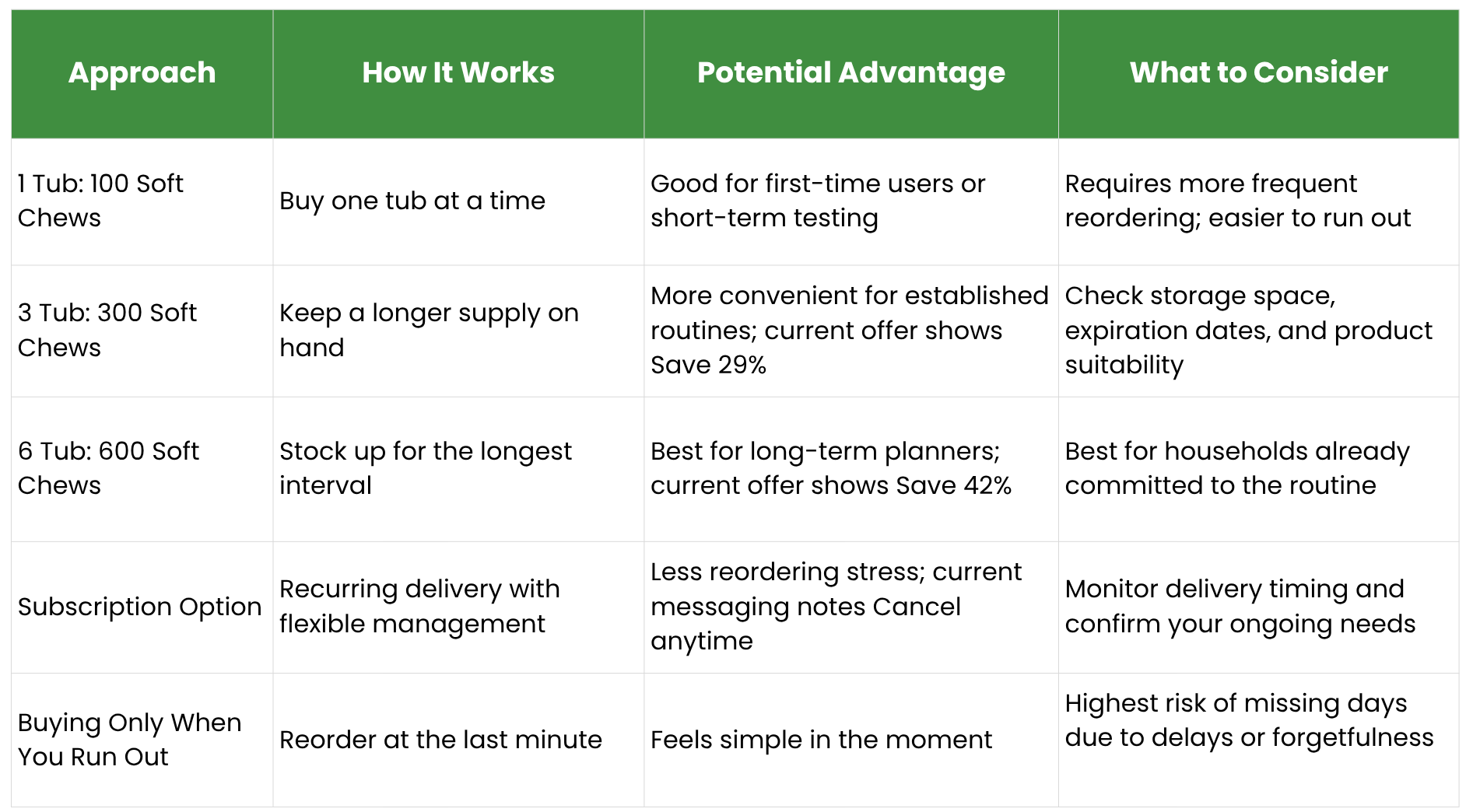
This kind of planning is not about buying more for the sake of buying more. It is about choosing the amount that makes your daily routine easier to maintain. If you are trying the product for the first time, one tub may be the sensible place to start. If the routine is already part of your life and you know it works well for your household, a 3-tub or 6-tub option may reduce last-minute stress.
Building a Routine That Works for Multi-Pet Homes
When you live with both dogs and cats, convenience becomes especially important. Even the most organized pet parent can feel stretched when feeding schedules, supplements, grooming, and general care all need to happen at once. This is where routine design matters just as much as product choice.
Try attaching wellness habits to events that already happen every day. If breakfast is always served at the same time, that can be the reminder for daily soft chews. If your dog always gets a quick wipe-down or coat check after walks, make that the time to inspect for anything unusual. If your cat enjoys a short evening cuddle or brushing session, use it as a regular opportunity to notice skin or coat changes.
Environmental care should fit into the same rhythm. Wash bedding on a predictable schedule, vacuum the areas where pets spend the most time, and keep an eye on rugs, cat trees, sleeping cushions, and household corners where loose fur and debris gather.
Planning ahead can also make the routine feel lighter. Instead of noticing an empty tub only after the last chew has been used, keeping a backup on hand means the routine continues without interruption while you handle your next order.
Making GCP Flea & Tick Natural Defense Part of Everyday Care
For households that want a simple daily addition to a broader seasonal care routine, GCP Flea & Tick Natural Defense offers both dog and cat formulas, making it easier to support both pets within one familiar system. Rather than treating the product as a stand-alone replacement for veterinary flea and tick care, it makes more sense to position it as one part of a thoughtful routine that also includes coat checks, household cleaning, grooming, and veterinarian guidance.
The current bundle options shown include 1 tub with 100 soft chews, 3 tubs with 300 soft chews, and 6 tubs with 600 soft chews, along with a subscription option that notes flexibility and current savings. For established users, this can remove some of the pressure of having to reorder constantly, especially in multi-pet households where supplies can move faster than expected.
For dog parents, the image also provides weight-based chew guidance, which can make the routine feel easier to follow at a glance. For cat parents, the best approach is to use the cat-specific formula exactly according to its label and your veterinarian’s advice.
Frequently Asked Questions
-
Indoor pets can still have some level of exposure through other animals, people, travel, or items brought into the home. Your veterinarian can help you decide what kind of year-round routine makes sense for your pet’s lifestyle and local conditions.
A Steady Routine Makes Seasonal Care Feel Simpler
The most successful pet care routines are usually not the most complicated ones. They are the ones that fit naturally into everyday life, remain manageable when schedules get busy, and reduce the number of last-minute decisions you have to make.
For flea and tick wellness, that means thinking in terms of consistency instead of panic. It means recognizing that dogs and cats may have different kinds of exposure, that home care matters alongside outdoor awareness, and that staying stocked can make your routine much easier to follow.
A product does not need to promise everything to be useful. Sometimes the real value lies in helping you stay organized, consistent, and prepared. When your routine is simple enough to keep going, seasonal care becomes one less thing to worry about.
Keep Their Daily Routine Covered With GCP Flea & Tick Natural Defense
GCP Flea & Tick Natural Defense is available for both dogs and cats, making it a convenient option for pet parents who want a more unified seasonal wellness routine across the household. With single-tub, 3-tub, and 6-tub bundle choices, plus a subscription option, it is designed to fit both first-time buyers and long-term planners who want daily care to feel easier to manage.
-
Available in dog and cat formulas
-
1 tub = 100 soft chews
-
3 tubs = 300 soft chews
-
6 tubs = 600 soft chews
-
Current bundle messaging shows Save 10%, Save 29%, and Save 42%
-
Subscription option available with cancel anytime messaging
-
Dog image guidance shows 1 chew daily for 10–25 lbs, 2 chews daily for 25–50 lbs, and 3 chews daily for 50–100 lbs
-
Easy to pair with meals or another daily pet-care habit
-
Complements coat checks, clean bedding, household care, and veterinary guidance
-
Designed to support a broader year-round pet wellness routine
If you are caring for both a dog and a cat, choosing products that work within the same daily rhythm can make your routine much easier to maintain. GCP Flea & Tick Natural Defense offers that convenience, along with bundle options that may help reduce reorder stress, so you can focus more on consistent care and less on whether you remembered to restock.
Reference
Rust, M. K. (2017). The biology and ecology of cat fleas and advancements in their pest management: A review. Insects, 8(4), 118. https://doi.org/10.3390/insects8040118
For all general inquiries, please contact us at info@guardianschoice.com
© Copyright. All rights reserved.