
Cat Love Bites: Why They Happen and How to Respond
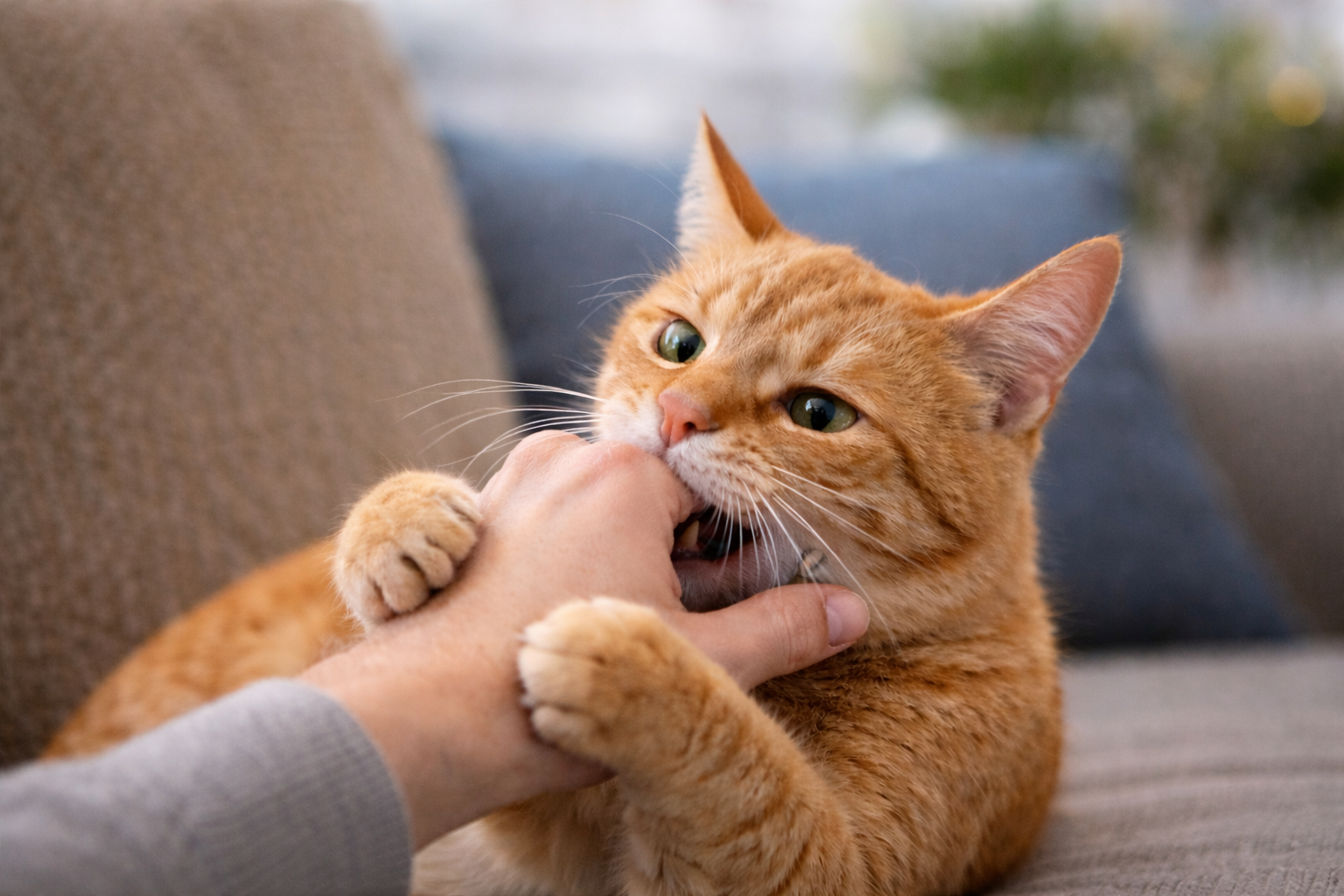
“Love bites” are a common feline behavior that can signal affection, overstimulation, or a shift in mood. Cats often communicate through subtle physical cues, and a gentle nip is one way they express boundaries. By learning to recognize early signals and maintaining a consistent routine, pet parents can better understand their cat’s behavior and create a calmer, more predictable interaction.
Why Cats Nip During Affection
One moment, your cat is purring, leaning into your hand, and fully relaxed. The next moment, they deliver a quick nip. It feels sudden, but in most cases, it is not unpredictable.
Cats experience touch differently from humans. What feels comforting at first can become overwhelming when repeated for too long. This shift can happen quickly, especially in sensitive areas like the lower back or tail base.
Nipping becomes a form of communication. It is your cat’s way of saying that something has changed. Instead of viewing it as negative behavior, it helps to see it as feedback.
The Psychology Behind the “Love Bite”
In feline behavior, nipping is not unusual. It begins early in life. Kittens use their mouths to explore, play, and interact with littermates. These interactions teach boundaries and control.
As cats grow, this behavior evolves rather than disappears. Adult cats may use gentle bites in three main ways:
-
Affectionate Grooming Cats groom those they trust. A small nip may be part of this behavior, similar to how they would groom another cat
-
Overstimulation Repetitive petting can trigger sensory overload. The bite acts as a signal that the threshold has been reached
-
Play Behavior Cats are natural hunters. A quick nip may be an invitation to engage in interactive play
Research in feline behavior suggests that cats rely heavily on environmental cues and learned interactions to guide their responses. Guidance from the American Veterinary Medical Association (AVMA) highlights how consistent interaction patterns influence behavior over time.
Reading the Warning Signs Before the Bite
Cats rarely bite without warning. The challenge is that their signals are subtle and easy to miss.
Common pre-bite signals include:
-
A tail that begins to flick or lash
-
Ears rotating backward or flattening
-
Pupils becoming more dilated
-
A sudden pause in purring
-
Muscle tension in the body
These signals often appear seconds before the bite. Recognizing them early allows you to stop interaction before the threshold is crossed.
Research available through the National Center for Biotechnology Information (NCBI) suggests that animals, including cats, communicate discomfort through changes in body language before escalating behavior.
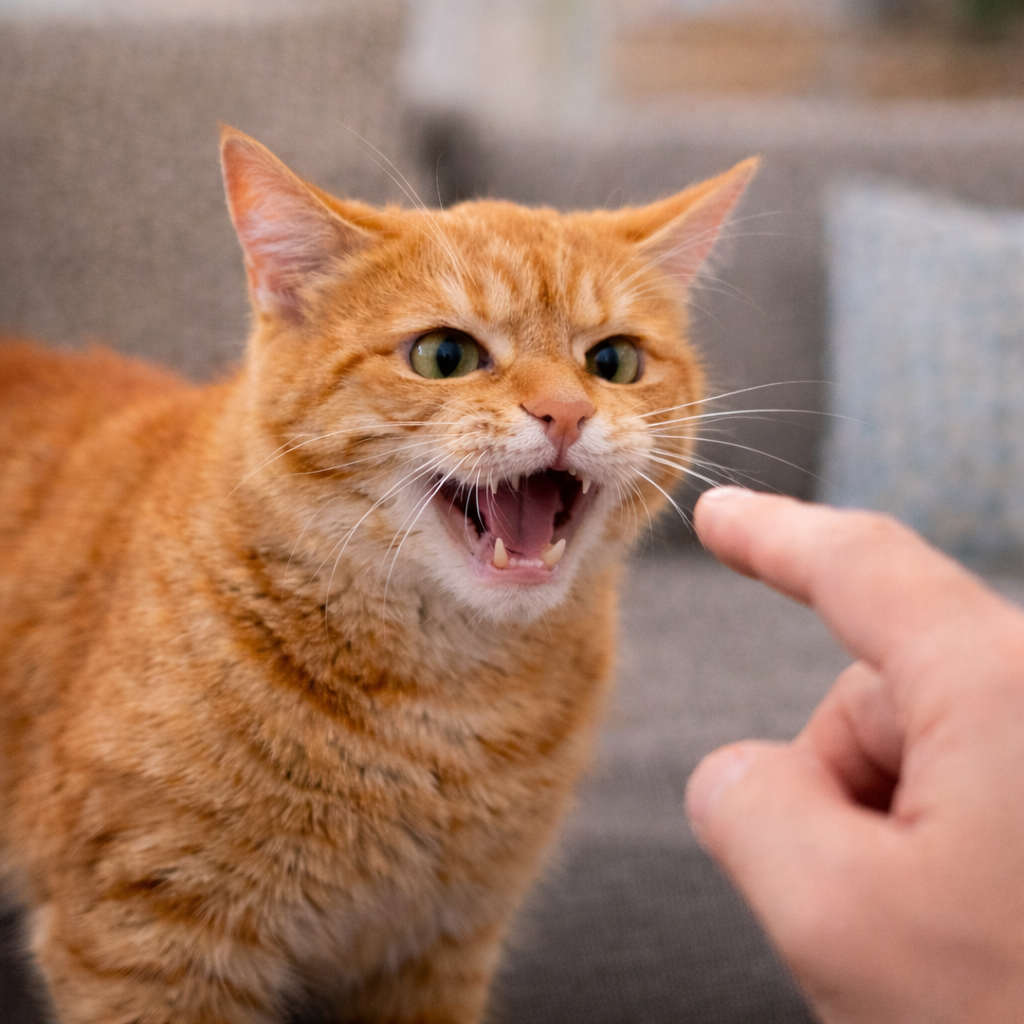
Love Bites vs. Aggression: Knowing the Difference
Not all bites are the same. Understanding the difference helps guide your response.
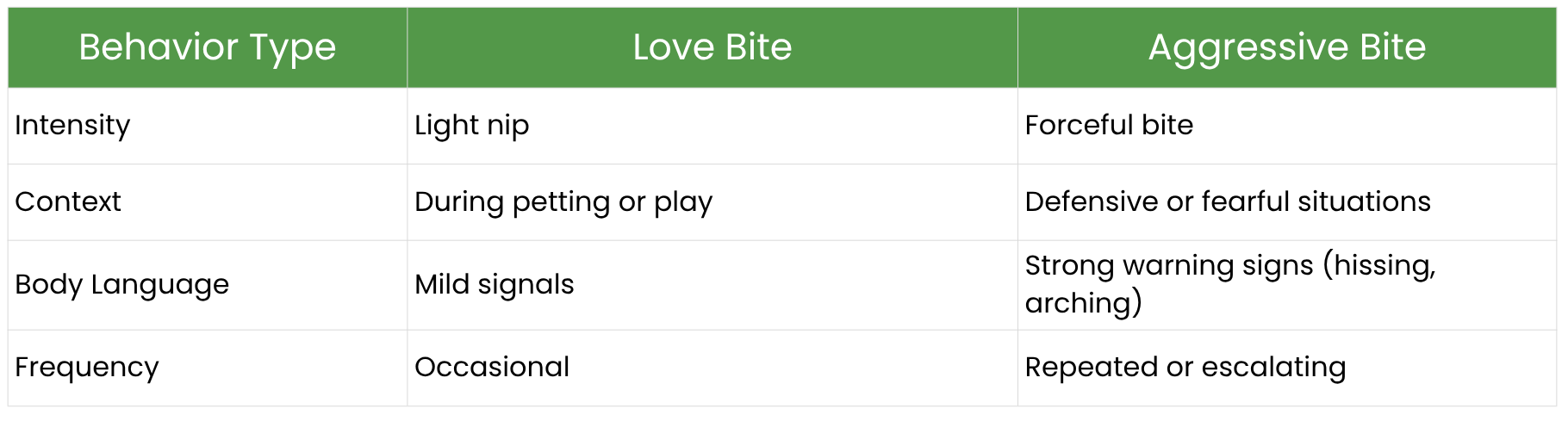
A love bite is usually controlled and brief. Aggressive behavior tends to be more intense and accompanied by stronger signals.
This distinction matters because the response should match the behavior. Treating a communication signal as aggression can create confusion for your cat.
How to Respond Without Reinforcing the Behavior
Your reaction plays a bigger role than most pet parents realize. Cats are highly observant and learn through patterns, not punishment. Every time your cat nips and you respond in a certain way, you are teaching them what happens next. Over time, these repeated interactions shape future behavior.
If your cat nips, the goal is not to “correct” them in the moment, but to avoid accidentally turning the behavior into a game or a habit.
Here’s how to respond effectively:
-
Avoid pulling your hand away quickly Sudden movement can mimic prey behavior. From your cat’s perspective, your hand becomes something to chase, grab, or bite again. This can unintentionally turn a small nip into a playful hunting sequence.
-
Stay still for a moment Pausing removes the stimulation. It signals that the interaction is no longer engaging or rewarding. This brief stillness helps de-escalate the moment without adding excitement.
-
Gently withdraw your hand Instead of reacting quickly, slowly move your hand away once your cat releases. This keeps the interaction calm and avoids triggering further chasing behavior.
-
Redirect their energy to an appropriate outlet Cats often bite because they need an outlet for energy or instinct. Offering a toy, wand, or interactive object gives them something more appropriate to engage with. This helps shift the behavior rather than suppress it.
-
End the interaction calmly When a nip happens, it is often a signal that your cat has reached their limit. Respecting that boundary by ending the interaction teaches your cat that communication works, which can reduce the need for stronger signals in the future.
It’s also important to avoid reacting with loud noises, tapping, or punishment. These responses can create confusion or stress, and in some cases, may increase defensive behavior rather than reduce it.
Pulling away suddenly, overreacting, or turning the moment into play can reinforce the very behavior you are trying to reduce. Staying calm, predictable, and consistent helps your cat understand what to expect.
Over time, these small, repeated responses build clarity. Your cat begins to associate gentle communication with calm outcomes, which supports more predictable and balanced interactions.
The Role of Routine and Internal Balance
Behavior is not just about isolated moments. It is influenced by patterns over time.
Cats thrive on predictability. When routines are consistent, they are less likely to become overstimulated or reactive. Feeding schedules, playtime, and interaction patterns all contribute to this balance.
Research suggests that environmental stability plays a role in reducing stress-related behaviors in animals. When routines are predictable, behavioral responses tend to become more consistent.
This does not eliminate behaviors like love biting, but it can make them more predictable and manageable.
Where GCP Fits Into Your Cat’s Routine
A consistent routine is one of the most effective ways to create predictability in your cat’s behavior. Feeding schedules, playtime, and interaction patterns all contribute to how your cat responds throughout the day.
GCP products are designed to fit into these existing habits, making it easier to maintain consistency without adding extra steps.
-
GCP Purrbiotics Easily mixes into your cat’s meals, making it a seamless part of feeding time. Its format helps maintain consistency, especially for cats that are sensitive to changes in routine.
-
GCP Cat L-Lysine Designed for simple daily use, this can be incorporated into regular feeding or treat routines, helping maintain structure without disruption.
-
GCP Flea & Tick Natural Defense for Cats Fits naturally into grooming and hygiene routines, supporting overall care without the need for complicated application steps.
Rather than introducing something entirely new, these products are meant to support what you are already doing—feeding, caring, and interacting with your cat every day.
Simple Daily Integration
Maintaining a routine becomes much easier when products are simple, flexible, and designed for real-life use. GCP focuses on practical formats that align with everyday pet care habits.
-
Easy-to-administer formats (powder and soft chews)
-
Can be integrated into meals or treat time
-
No complicated preparation or transitions needed
-
Works well for single or multi-cat households
-
Designed for consistent, repeatable daily use
By removing friction from daily care, these products support one of the most important factors in behavior—consistency.
Frequently Asked Questions
-
This behavior is often part of grooming. Cats use licking as a bonding activity, and a small nip may signal the end of the interaction. It reflects a natural sequence rather than a sudden change in mood.
A Better Way to Understand Your Cat
Love bites are not a problem to eliminate. They are a form of communication to understand.
By paying attention to signals, maintaining consistent routines, and supporting daily habits with products like GCP Purrbiotics and Cat L-Lysine, you create an environment where interactions feel more predictable and balanced.
Because the goal is not to stop your cat from communicating. It is to understand what they are already trying to say.
Supporting a More Predictable Routine with GCP for Cats
Understanding your cat’s behavior is one part of the equation. The other is creating an environment where that behavior becomes easier to manage and anticipate.
This is where a consistent daily routine plays a role. Small, repeatable habits—like feeding at the same time, engaging in regular play, and maintaining simple care routines—help reduce unpredictability. Over time, this structure can influence how your cat responds during interactions, including moments that might otherwise lead to overstimulation.
GCP’s cat product line is designed to support that consistency without adding complexity:
-
GCP Flea & Tick Natural Defense for Cats A convenient chew format that fits into everyday care, making it easier to maintain regular hygiene habits
-
GCP Purrbiotics Daily Probiotics A simple addition to feeding routines, especially for cats that prefer familiar flavors and textures
-
GCP Cat L-Lysine Designed for easy daily use, helping pet parents maintain a consistent routine without disruption
These products are not positioned as behavioral solutions. Instead, they are built to support structure, which plays a key role in how predictable and manageable your cat’s behavior becomes over time.
When routine becomes easier to maintain, interactions become easier to understand. And when you understand your cat better, even something as confusing as a “love bite” starts to make sense.
For all general inquiries, please contact us at info@guardianschoice.com
© Copyright. All rights reserved.